AI Liquid Cooling Manufacturing Partner

Liquid Cold Plate Supplier for Australian Engineering

ToneCooling Australia is the AI liquid cooling manufacturing partner for Australian engineering teams — the local customer engineering support and supply entity. Cold plate design, engineering, and manufacturing are delivered by our IATF 16949-aligned partner facility in Huizhou, Guangdong, China. Australian customer engineering support, project coordination, and AS/NZS compliance services are delivered by our Carlton, Victoria team. Direct-to-chip cold plate kits for NVIDIA GB200, GB300, H200, AMD EPYC SP5, and Intel Birch Stream platforms.

≤ 1×10⁻⁹mbar·L/s helium leak rate sensitivity
99 %TLP diffusion bonding production yield
2–4 weeksAI server cold plate prototype lead time
Customprogramme volume agreed at quotation
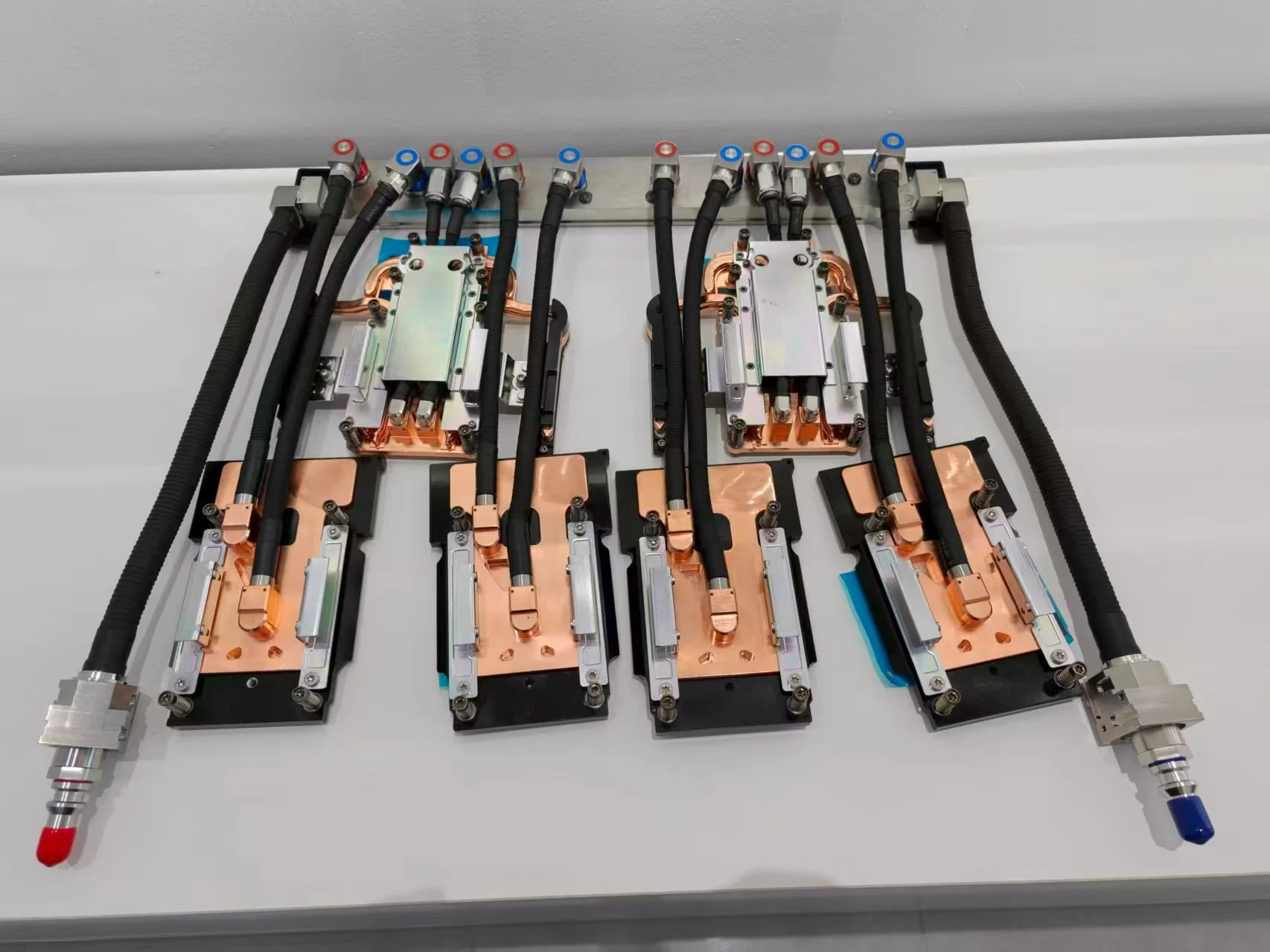
NVIDIA GB200 Grace Blackwell direct-to-chip cold plate kit by ToneCooling Australia — copper micro-channel, vacuum-brazed, helium-leak tested
Process & standards glossary (AU engineering reader): TLP = Transient Liquid Phase diffusion bonding · FSW = Friction Stir Welding · CAB = Controlled Atmosphere Brazing · PPAP = Production Part Approval Process · IATF 16949:2016 (international automotive QMS) · ISO 9001:2015 (quality management) · AS/NZS 60068-2-14IEC 60068-2-14:2009 (thermal cycling endurance) · IEC 62619:2017 (industrial battery safety) · AS/NZS 5139:2019 (BESS installation) · AS/NZS 4777.2:2020 (grid-connected inverter).
Page reviewed by ToneCooling Australia Customer Engineering Support Team · Carlton, VIC · Last reviewed: 28 April 2026 · About the team →
30,000 m²
primary manufacturing facility (Huizhou, expanded 2026)
ToneCooling Group 2026 corporate filing
1,000,000+
cold plates produced per year
Group annual production capacity (2026)
Patented IP
manufacturing process portfolio
2026 group portfolio
20+ yrs
precision thermal management since 2004
Founded Guangdong, China

What We Provide

What does ToneCooling Australia do?

ToneCooling Australia supplies four product families to Australian engineering teams: GPU cold plate kits (NVIDIA GB200, GB300, H200), CPU cold plates (AMD EPYC SP5, Intel Birch Stream), BESS cold plates (TC-1P104S battery module thermal hardware), and custom-manufactured cold plate programmes. Each product ships with hoses, manifold-ready architecture, and quick-disconnect couplings for rack-level integration.
ToneCooling vacuum-brazed copper cold plate for NVIDIA GB200 Bianca module showing micro-channel fin structure
1

Direct-to-chip cold plates

Cold plates for GPU and CPU platforms, manifold-ready and tuned to your CDU's pressure-drop budget.

GB200 / GB300 / H200 / SP5 / Birch Stream
EPDM-lined high-flex tubing with Stäubli RBE03 dry-break quick-disconnect coupling
2

Complete cooling kits

Cold plate plus high-flex tubing, manifold, and quick-disconnect couplings as a pre-assembled, leak-tested unit.

Stäubli RBE03 · CPC NS6
Rack-level distribution manifold aligned to OCP DC-MHS port-pitch standard
3

Rack-level integration support

OCP DC-MHS-aligned manifold pitch, CDU compatibility verification, and field-replaceable serviceability.

Vertiv · CoolIT · Stulz · Motivair
ToneCooling Australia customer engineering support team reviewing thermal report at Carlton, Victoria office
4

Customer engineering support

Carlton-based AU engineering support team in your time zone. Project coordination with the Huizhou design and engineering team, AS/NZS compliance documentation, and 24-hour response.

AEST / AEDT business hours

Position in the Stack

Where does ToneCooling Australia fit in the liquid cooling stack?

ToneCooling Australia operates in the middle layer of the data centre liquid cooling stack — between the GPU/CPU package and the rack-level CDU loop. We supply cold plates, hose and quick-disconnect assemblies, and manifold-ready cooling modules. We do not compete with CDU vendors (Vertiv, Stulz, CoolIT) at the facility layer; we complement them at the chip and rack-tray layer.

ToneCooling Australia's middle-layer scope: cold plates, hose & QD assemblies, and manifold-ready cooling modules. Not consumer PC liquid cooling, not facility-side CDUs.

Skived copper micro-channel cold plate fin field, hydraulic diameter ≤ 1.5 mm
EPDM-lined high-flex tubing with Stäubli RBE03 dry-break quick-disconnect coupling
Rack-level distribution manifold aligned to OCP DC-MHS port-pitch standard

Supported Platforms

Which AI server platforms does ToneCooling Australia cool?

Direct-to-chip cold plates engineered for the NVIDIA GB200 NVL72 platform and aligned to the Open Compute Project DC-MHS specification.

Five reference platforms drive AI server cold plate demand from Australian sovereign cloud, HPC refresh (Pawsey, NCI), and edge compute teams: NVIDIA GB200 (1,200 W + 1,200 W + 300 W per Bianca module), GB300 Grace Blackwell Ultra (engineering preview), H200 (8-GPU baseboard, 700 W per die), AMD EPYC SP5 (LGA6096), and Intel Birch Stream (Granite Rapids, Sierra Forest). Cold plate kits include hose, manifold, and quick-disconnect coupling integration support.
GB200 cold plate
NVIDIA
GB200
Direct-to-chip kit for Grace Blackwell. 2,700 W per Bianca module. NVL2/NVL36/NVL72 ready.
GB300 cold plate
NVIDIA
GB300
Engineering preview. Manifold-ready architecture for Grace Blackwell Ultra.
H200 cold plate
NVIDIA
H200
8-GPU baseboard cold plate. 8 × 700 W per die plus NVSwitch zone.
SP5 cold plate
AMD
EPYC SP5
LGA6096 socket. Genoa, Bergamo, Genoa-X, Turin compatible. 400 W reference.
Birch Stream cold plate
Intel
Birch Stream
Granite Rapids and Sierra Forest. 350–500 W reference TDP.

View GPU cold plate kits   View CPU cold plate kits

Core Manufacturing IP

What makes TLP diffusion bonding different from vacuum brazing?

Transient Liquid Phase (TLP) diffusion bonding is ToneCooling's proprietary cold plate manufacturing process. It forms a continuous metallurgical grain structure across the bonding interface, eliminating the brittle braze-filler interface layer typical of conventional vacuum brazing. The result: stronger bonds, faster production cycles, higher yield, and improved thermal-cycling reliability.
Manufacturing parameterTLP (ToneCooling)Vacuum brazing
Bonding cycle time~ 5 min~ 1 hour
Bond strength (relative)0.850.75
Production yield~ 99 %~ 90 %
MicrostructureContinuous metallurgical grainFiller-metal interface
VerificationUltrasonic C-scan, every unitHelium leak + pressure
Best fitAI server, HPC, high-cycleLower TDP, cost-sensitive
Ultrasonic C-scan inspection comparison — TLP diffusion bonded cold plate (uniform void-free interface, left) versus conventional vacuum brazing (filler-layer artifacts, right)
Ultrasonic C-scan: TLP-bonded plate (left) shows uniform blue, indicating a void-free interface. Conventional vacuum-brazed competitor samples (right) show filler-layer artifacts and bond-line voids.
≤ 1×10⁻⁹
mbar·L/s
helium leak
100 %
production unit
C-scan verified
0.85
bond strength
(vs 0.75 brazing)
Production-line verification. Every TLP-bonded cold plate undergoes ultrasonic C-scan inspection (100 %, not sample-based) plus helium leak testing to ≤ 1×10⁻⁹ mbar·L/s. Test documentation accompanies every Australian shipment.

Bond integrity is verified on every production unit using ultrasonic C-scan inspection. Uniform blue regions on the C-scan image indicate void-free bonding — the absence of internal voids or unbonded interfaces. The TLP process is the manufacturing IP behind our reliability claims for thermal-cycling-critical applications such as direct-to-chip GB200, H200, and grid-forming PCS cooling.

Read the TLP diffusion bonding deep-dive

Quality Assurance

How is cold plate quality validated before shipment to Australia?

Validation envelope aligned to the ASHRAE TC 9.9 Datacom liquid cooling guideline (W32 / W40); standards mapped to Standards Australia.

Every ToneCooling cold plate passes four production-line validation tests: high-sensitivity helium leak detection (≤ 1×10⁻⁹ mbar·L/s), ultrasonic C-scan inspection of the bonded interface, pressure and flow performance testing, and environmental reliability testing across −40 °C to 150 °C and 20–98 % RH. Lot-traceable inspection certificates accompany every shipment.

Helium leak detection

High-sensitivity helium leak detection ensures hermetic sealing. Detects micro-leakage defects after welding and assembly.

Sensitivity: ≤ 1×10⁻⁹ mbar·L/s

Ultrasonic C-scan inspection

Non-destructive inspection of bonded interfaces. Detects internal voids or unbonded regions across the cold plate area.

100 % production unit coverage

Pressure and flow performance

Measures coolant flow resistance and pressure drop. Verifies pressure-holding capability and structural integrity.

Copper and aluminium variants

Environmental reliability

Thermal cycling tests simulate long-term operating conditions. Validates structural stability under temperature and humidity variations.

−40 °C to 150 °C · 20–98 % RH
HLT560 helium leak detection equipment used for cold plate hermetic sealing verification
HLT560 · Helium leak detector
Ultrasonic scanner S800 for non-destructive bonding interface inspection
S800 · Ultrasonic C-scan
Flow resistance tester measuring coolant pressure drop across cold plate channels
Hydraulic ΔP tester
CTH thermal-humidity test chamber, −40 °C to 150 °C, 20–98 % RH range
CTH chamber · −40 to 150 °C

Manufacturing

What manufacturing capability backs ToneCooling Australia?

ToneCooling Australia engineering is backed by the parent group's 30,000 m² primary manufacturing facility in Huizhou, Guangdong, China (most recent footprint expansion 2026) — ISO 9001-certified with annual production capacity of approximately 1,000,000 cold plates. Manufacturing partner facility operates IATF 16949-aligned production with full lot traceability via laser-engraved QR code on each unit.

Precision machining

Multi-axis CNC machining centres for complex cooling channels. Machining accuracy up to ± 0.003 mm.

🔥

Advanced welding

Proprietary TLP diffusion bonding, vacuum brazing, induction welding, and friction stir welding (FSW).

🔍

Inspection & testing

Helium leak detection, ultrasonic C-scan, pressure and flow resistance testing on every production unit.

📦

Production capability

Dedicated liquid cooling line, standardised QC processes, ~ 1,000,000 cold plates per year capacity.

200+ employees (40 % technical staff) · Patented manufacturing IP portfolio · Active engineering R&D programme

Australian Industry Extensions

Which Australian industries do you serve beyond AI servers?

Beyond the primary AI server and data centre liquid cooling focus, ToneCooling Australia covers four AU-relevant secondary industries: battery energy storage systems (BESS), grid inverter and power electronics, heavy-EV thermal management, and industrial cold plates. These extensions match Australian Energy Market Operator (AEMO) Integrated System Plan deployment timelines and the Federal Capacity Investment Scheme.
BESS cabinet thermal

BESS & energy storage

Cold plates for grid-scale battery cabinets (TC-1P104S), Power Conversion Systems, and containerised storage. AS/NZS 5139 design-aware. AEMO 2024 ISP calls for 49 GW dispatchable storage by 2050.

BESS cooling →
IGBT module cooling

Grid inverter & power electronics

Cold plates for IGBT, SiC, GaN modules in grid-forming PCS, photovoltaic central inverters, and rail traction (Inland Rail, Sydney Metro West, Cross River Rail).

Power electronics cooling →
Heavy-EV traction

Heavy-EV thermal management

Cold plates for mining trucks (Fortescue, BHP, Rio Tinto programmes), electric buses (Custom Denning, Volgren, BusTech), and marine electrification (Incat, Austal). Traction inverter and motor-controller cold plates supplied through the Power Electronics programme.

Power electronics cooling →
Industrial cold plate

Industrial cold plates

Custom cold plates for fibre and CO₂ laser sources (IPG, Coherent, Trumpf), medical CT/MRI imaging, factory automation drives, semiconductor process tools, and welding equipment.

Industrial cooling →

Australian Compliance

How do you support compliance for Australian projects?

ToneCooling structures cold plate documentation around the standards your Australian installation auditor will reference: AS/NZS 5139:2019 (battery system installation), AS/NZS 4777.2:2020 (grid-connected inverter), AS/NZS 60068-2-14 (thermal cycling), AS/NZS 60529 (IP rating). Material substrates are dual-certified RoHS 2.0 plus PFAS-free per SGS Shanghai (steel, EN 17681-1:2022) and CNAS-accredited Wonder Laboratories (aluminium).
Compliance areaDocumentation providedReference standard
Helium leak tightnessLeak-rate certificate per unitInternal QMS, IATF 16949-aligned
Pressure / hydrostatic testPressure-test certificate per batchQC/T 468-2010 · AS 1210 (where applicable)
Thermal cycling enduranceCycle endurance test reportAS/NZS 60068-2-14 / IEC 60068-2-14
Ingress protection (outdoor / coastal)IP65 / IP66 evidenceAS/NZS 60529
Salt spray (coastal sites)Salt-spray test reportISO 9227
Material RoHS & PFAS-freeThird-party certificatesRoHS 2.0 (2011/65/EU + 2015/863) · EN 17681-1:2022
First Article InspectionFAI reportAS9102
PPAP documentationLevels 1–5 supportedIATF 16949-aligned
Country of origin (AU import)ChAFTA Certificate of OriginChina-Australia FTA · Australian Consumer Law §29

Commercial Terms

How is the engagement structured?

Engagement cycle for AU programmes: Carlton-coordinated engineering response on receipt of complete RFQ; NDA execution; joint Carlton + Huizhou DFM review session; tooled prototype manufacturing and shipping. MOQ, prototype and production lead times, and annual capacity are agreed at quotation per programme.
StageOwnerOutput
1. RFQ intake & engineering responseCarlton VIC team coordinated with Huizhou design and engineering teamThermal sensitivity table, process recommendation, draft AUD quote
2. NDA & DFM review sessionCarlton + Huizhou joint Zoom sessionCFD output, channel-topology proposal, hydraulic budget review
3. Prototype & production deliveryHuizhou manufacturing → AU customer siteLot-traceable QC certificates per shipment

Frequently Asked

Questions Australian engineers ask

Engineering & Technical
What does ToneCooling Australia do?

ToneCooling Australia is the AI liquid cooling supplier for Australian engineering teams — the local customer engineering support and supply entity. We supply direct-to-chip cold plates for NVIDIA GB200, GB300, H200, AMD EPYC SP5, and Intel Birch Stream platforms, plus secondary applications including BESS battery energy storage, grid-forming PCS power electronics, and heavy-EV thermal management.

Cold plate design, engineering, and manufacturing are performed at our IATF 16949-aligned partner facility in Huizhou, Guangdong, China. The Australian team in Carlton, Victoria delivers customer engineering support, project coordination, AS/NZS compliance services, and pre-sales engineering consultation.

Read more about ToneCooling Australia →
What is TLP diffusion bonding and why does it matter for cold plates?

TLP (Transient Liquid Phase) diffusion bonding is ToneCooling's proprietary cold plate manufacturing process. It forms a continuous metallurgical grain structure across the bonding interface, eliminating the brittle braze-filler interface layer found in conventional vacuum brazing.

Operational data: TLP cycles in 5 minutes per cold plate (vs 1 hour for vacuum brazing), bond strength 0.85 (vs 0.75), production yield 99 % (vs 90 %). Bond integrity is verified on every production unit using ultrasonic C-scan inspection.

Read the TLP diffusion bonding deep-dive →
How is cold plate quality validated before shipment to Australia?

Every cold plate is validated at our manufacturing partner facility before shipment. The standard validation pack includes: helium leak detection to a sensitivity of 1×10⁻⁹ mbar·L/s; ultrasonic C-scan inspection of the bonded interface; pressure and flow performance testing; environmental reliability testing across −40 °C to 150 °C and 20–98 % RH.

Lot-traceable inspection certificates accompany every shipment to Australia.

Read the validation methodology →
Which Australian industries does ToneCooling Australia serve beyond AI servers?

Beyond the primary AI server and data centre liquid cooling focus, ToneCooling Australia serves four AU-relevant secondary industries: battery energy storage systems (TC-1P104S BESS cold plate, AS/NZS 5139 design-aware); grid inverter and power electronics (74 % of AU's BESS pipeline now uses grid-forming inverters per AEMO Q1 2026); heavy-EV thermal management (mining trucks, electric buses, marine electrification); and industrial cold plates (fibre and CO₂ laser, medical imaging, robotics, semiconductor process tools, welding equipment).

See all solutions →
Procurement & Compliance
What is the prototype lead time and minimum order quantity?

Prototype minimum order available on request for tooled prototypes across all product families. AI server cold plate prototypes (GB200, H200, SP5, Birch Stream) ship as agreed at quotation door-to-door from Huizhou to Australian capital cities. BESS, power electronics, and heavy-EV cold plate prototypes ship as agreed at quotation. Production scale and lead times are agreed during quotation.

Read the RFQ input checklist →
What Australian compliance documentation does ToneCooling provide?

ToneCooling structures cold plate documentation around the standards your Australian installation auditor will reference: AS/NZS 5139:2019 design-aware (BESS battery system installation), AS/NZS 4777.2:2020 design-aware (grid-connected inverter), AS/NZS 60068-2-14 thermal cycling endurance reports, AS/NZS 60529 IP rating evidence.

Material substrates are dual-certified RoHS 2.0 plus PFAS-free per SGS Shanghai (steel) and CNAS-accredited Wonder Laboratories (aluminium). ChAFTA Certificate of Origin is supplied with every shipment.

See AS/NZS compliance scope →
How does ChAFTA affect import duty on ToneCooling cold plates?

Most cold plate categories under HS 8419 / 8537 carry 0–5 % Australian import duty under the China-Australia Free Trade Agreement (ChAFTA) when accompanied by a Certificate of Origin issued by an authorised China-side body. ToneCooling provides ChAFTA-compliant Certificate of Origin documentation as part of every shipment package.

Confirm with your customs broker for your specific HS code declaration.

View AS/NZS standards reference →
Question not answered?

Send your TDP map, manifold sketch, or qualification scope to the Carlton engineering team. Carlton-coordinated engineering response within 24 working hours, with technical review by the Huizhou design team.

Request a Quote →

Continue Exploring

Explore ToneCooling Australia

SOLUTION

AI Server Liquid Cooling

Direct-to-chip cold plate kits for NVIDIA GB200, GB300, H200, AMD SP5, Intel Birch Stream.

View solution →
SOLUTION

BESS Liquid Cooling Solution

Cold plates for AU grid-scale battery storage; TC-1P104S real test data; AEMO ISP-aligned.

View solution →
CAPABILITY

TLP Diffusion Bonding

Core manufacturing IP — 5-min cycle, 99% yield, 0.85 bond strength. C-scan verified.

View capability →
RESOURCE

AI Server Cooling Design Guide

12-section engineering reference — channel topology, ΔP budget, manifold, CDU compatibility.

Read the guide →

Send your design brief to our Carlton team

A complete RFQ — TDP map, target ΔP and flow rate, qualification scope, lead time — receives a Carlton-coordinated response within 24 working hours, with technical review by the Huizhou design and engineering team, including a thermal sensitivity table, process recommendation, and draft quote in AUD.

Request a Quote Email info@tonecooling.com.au →
Step 1 · Within 24 h
Carlton acknowledges receipt; assigns a project lead in your time zone (AEST/AEDT).
Step 2 · 2–5 working days
Engineering response: ΔP budget, process recommendation, AUD draft quote.
Step 3 · DFM session
CFD-validated DFM review at Huizhou; CFD plots and channel-topology iteration.
Step 4 · Sample & PPAP
Prototype sampling, validation reports, PPAP Levels 1–5 on request.
"Send us your TDP map, manifold sketch, and qualification scope. You'll get a ΔP-budgeted reply within 24 hours — coordinated by our Carlton support team and reviewed by the Huizhou design and engineering team, not a form." — ToneCooling Australia customer engineering support team, Carlton VIC
Direct Engineering Contact
Email (RFQ + general)info@tonecooling.com.au
Email (post-NDA technical)engineering@tonecooling.com.au
Phone (AEST/AEDT)+61 420 936 669
OfficeSuite 69, 139 Cardigan Street, Carlton VIC 3053