
1
Custom channel topology
Bespoke micro-channel fin pitch, depth, and inlet/outlet routing tuned to your specific TDP map and ΔP envelope.
AI Server Liquid Cooling — Phase 1 Primary Solution
Direct-to-chip cold plate kits for NVIDIA GB200, GB300, H200, AMD EPYC SP5, and Intel Birch Stream — the five AI server platforms most deployed in Australian sovereign cloud, national research computing and edge AI. Cold plate design, engineering, and manufacturing are performed at our own IATF 16949-aligned manufacturing facility in Huizhou, Guangdong, China. The Carlton, Victoria team delivers customer engineering support, project coordination, and AS/NZS compliance documentation.

Engineering Reference & Standards
Section 1 of 10
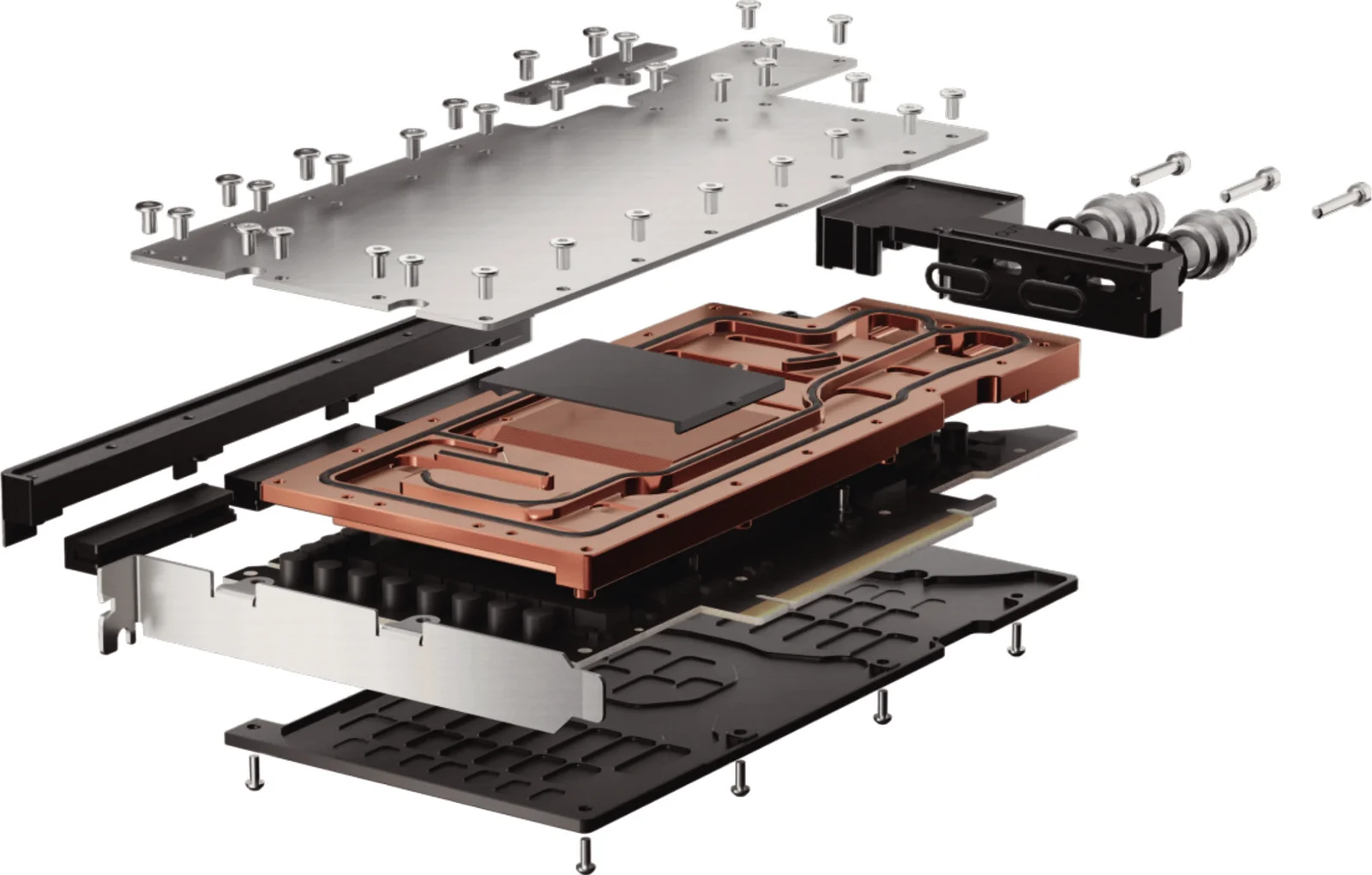
A direct-to-chip cold plate is a sealed copper or aluminium block mounted directly on the processor lid. Coolant enters through a manifold-connected port, passes through a micro-channel or skived-fin structure above the hottest area of the die, and leaves carrying most of the device’s heat. Because the heat is captured at the source, the air-handling system only has to deal with the small share of heat from memory, voltage regulators and other board components that are not cold-plated.
Air cooling reaches its hard limit between 8–25 kW per rack — beyond this, the volume of air required to remove heat exceeds what a hot-aisle / cold-aisle configuration can deliver. Single-phase direct-to-chip cooling extends the envelope to 80–120 kW per rack and beyond, by exchanging heat directly at the die surface where 90 %+ of the thermal load is generated. This shifts the thermal challenge from air movement to fluid hydraulics: pressure-drop budget across the cold plate, manifold design, quick-disconnect couplings, and the CDU's heat-rejection capacity to the facility loop.
ToneCooling Australia supplies the middle three layers — cold plates, hose & QD assemblies, manifold-ready cooling modules. Not consumer PC liquid cooling. Not facility CDUs.
Section 2 of 10



Rack cold plates
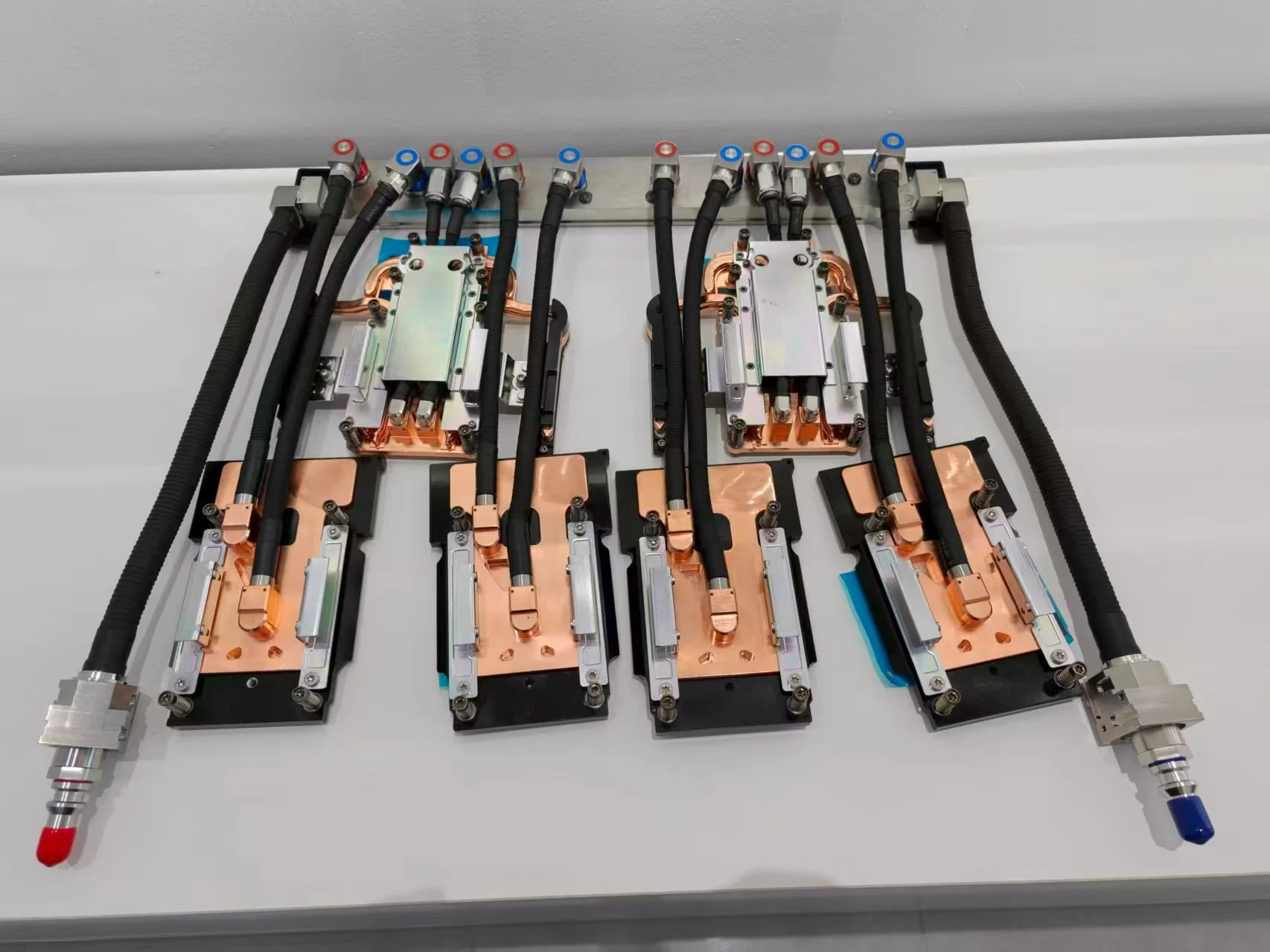
Short answer: an AI server rack cold plate is the copper plate mounted on each GPU and CPU in a liquid-cooled rack. Coolant from the rack manifold flows through its micro-channels and carries the chip heat to the coolant distribution unit (CDU). Each cold plate sets a flow rate and a pressure drop, and the rack manifold and CDU must supply both at the right inlet temperature.
| Reference data | GB300 4G+2C kit (4 GPU + 2 CPU) | GB200 kit |
|---|---|---|
| Heat load | GPU 1,066.94 W; CPU 485.46 W (tested) | 1,200 + 1,200 + 300 W (specified) |
| Flow per cold plate | GPU 1.7 L/min; CPU 0.7 L/min | 2.5 L/min |
| Pressure drop | GPU 12.06 kPa; CPU 10.39 kPa | 35 ± 5 kPa |
| Thermal resistance / surface limit | GPU 0.0130–0.0133 °C/W; CPU 0.0220 °C/W | Cold plate surface below 43 °C |
| Test coolant | Pure water, steady state | Pure water, 25 ± 2 °C inlet |
Source: ToneCooling datasheets TC-BZP-GB300-01A (tested 2026-03-20) and TC-BZP-GB200-01A. Download both from the product pages.
To size the rack, multiply the flow per cold plate by the number of modules, add manifold and quick-disconnect losses, and check that the CDU can deliver that flow and head with margin. For one or a few racks, an in-rack CDU is usually the simplest start; for a full row, an in-row CDU feeds every rack from one secondary loop. Compare in-rack and in-row CDUs →
Section 3 of 10
| Platform | Reference flow rate | Typical ΔP | Coolant | Inlet temperature window |
|---|---|---|---|---|
| NVIDIA H200 (8-GPU baseboard) | 10 LPM | ≤ 40 kPa | Pure water (datasheet) | 45 °C (datasheet test) |
| NVIDIA GB200 (Bianca, brazed + laser-welded) | 2.5 L/min (tested) | 35 ± 5 kPa (tested) | 50/50 EGW or PG25 | 20–40 °C (ASHRAE W40) |
| NVIDIA GB300 (4G+2C kit) | GPU 1.7 L/min · CPU 0.7 L/min (tested) | GPU 12.06 kPa · CPU 10.39 kPa (tested) | Pure water (datasheet) | 19.9 °C GPU / 23.6 °C CPU inlet (datasheet test) |
| AMD EPYC SP5 (LGA6096) | 5–8 L/min | 15–25 kPa | 50/50 EGW | 20–32 °C (ASHRAE W32) |
| Intel Birch Stream | 5–8 L/min | 15–22 kPa | 50/50 EGW | 20–32 °C (ASHRAE W32) |
Datasheets (PDF, ToneCooling Australia): GB300 4G+2C kit · GB200 kit · H200 assembly · H100 assembly. Other GPU and CPU cold plates are custom-built and quoted per programme.
Pressure drop is the primary hydraulic constraint at the cold-plate level. Too high — your CDU pump curve cannot meet the rack's flow demand at the design point. Too low — channel residence time drops, and convective heat-transfer coefficient suffers. ToneCooling's DFM engineering review (performed at our Huizhou facility, coordinated by the Carlton customer engineering support team) runs conjugate-heat-transfer CFD on your actual coolant chemistry, flow rate, and inlet-temperature window before committing to tooling.
Section 4 of 10
High ambient temperature. Summer peaks above 45 °C are common at inland and northern sites. Designing the technology cooling loop for warm-water operation, within the ASHRAE W32 or W40 facility water classes published by ASHRAE TC 9.9, lets dry coolers reject heat for more hours of the year and cuts chiller energy. It also raises the coolant temperature at the cold plate inlet, so the cold plate’s thermal resistance must leave enough margin to the processor’s case temperature limit. We size channel topology and flow against the actual inlet window for the site, not a generic 25 °C assumption.
Water scarcity. Evaporative cooling towers consume water, and water availability now features in site selection and approvals in drought-exposed regions. Closed-loop direct-to-chip cooling recirculates the same coolant, and pairing it with dry coolers removes evaporative water use on the heat rejection side.
Brownfield air-cooled halls. Much of Australia’s existing capacity was built for air. Liquid-to-air CDUs let individual high-density racks move to direct-to-chip cooling without new facility pipework, while the rest of the hall stays on air. The cold plate specification is the same; the CDU choice changes.
Section 5 of 10
ToneCooling engineers the cold plates, manifolds and custom coolant distribution units together. The pressure drop of every branch is calculated on one model, the CDU pump is selected against that total, and the assembled loop is flow- and leak-tested with one set of records.
Section 6 of 10
Every cold plate is tested with a high-sensitivity helium mass-spectrometer leak detector to a sensitivity floor of ≤ 1×10⁻⁹ mbar·L/s. This is two orders of magnitude tighter than the typical industrial pressure-decay leak threshold and is required for hyperscaler-grade direct-to-chip cooling.
Sensitivity ≤ 1×10⁻⁹ mbar·L/sNon-destructive inspection of the bonded interface using ultrasonic C-scan imaging. The output is a 2-D image of the bonded plane — uniform colour indicates void-free bonding, dark patches indicate voids or unbonded zones. Performed on every production unit, not a sampled basis.
100 % production unit inspectionHydraulic ΔP measured against design specification at the rated flow rate, on the actual coolant chemistry your CDU will run. Pressure cycle testing to verify structural integrity at maximum working pressure plus a safety margin. Burst-pressure testing on sample units per lot.
Working pressure per datasheet: GB200 0.6 MPa · H200 assembly 1 MPaThermal cycling endurance per IEC 60068-2-14 / AS/NZS 60068-2-14 across −40 °C to 150 °C, with humidity exposure 20–98 % RH per IEC 60068-2-78. Salt-spray exposure per ISO 9227 / AS 2331.3.1 for coastal Australian deployments.
−40 °C to 150 °C · 20–98 % RHSection 7 of 10
| Metric | TLP diffusion bonding (ToneCooling) | Vacuum brazing (industry standard) | Why it matters |
|---|---|---|---|
| Microstructure | Continuous metallurgical grain | Brittle filler-metal interlayer | Eliminates the braze-filler weak point under thermal cycling fatigue |
| Bond verification | Ultrasonic C-scan | Ultrasonic C-scan | Same NDI method; both processes verified non-destructively |
Section 8 of 10
| Dimension | AI server cold plate | BESS cold plate (TC-1P104S reference) |
|---|---|---|
| Heat source | Single die / package, 700–2,700 W | 104 distributed cells, ~ 15 W each (1.56 kW total) |
| Heat flux density | High (concentrated) | Low (distributed) |
| Channel topology | Micro-channel fins (< 1 mm) | Stamped channels (3–8 mm) |
| Material | Copper (vacuum braze / TLP) or aluminium | Aluminium AL3003MOD + AL4045 brazing |
| Joining process | TLP diffusion bonding · vacuum brazing · FSW | Stamped-and-brazed (CAB) + laser welding |
| ΔT tolerance | ≤ 10 °C across plate | ≤ 6 °C cell-to-cell uniformity |
| ΔP budget | 15–35 kPa (CDU-constrained) | 10–25 kPa (BMS pump-constrained) |
| AS/NZS context | Data centre installation standards (AS/NZS 3000 facility loop) | BESS installation AS/NZS 5139:2019 + grid-connected inverter AS/NZS 4777 |
Both product families share ToneCooling's core validation methodology — helium leak ≤ 1×10⁻⁹ mbar·L/s, ultrasonic C-scan inspection, thermal cycling per AS/NZS 60068-2-14 — but the channel topology, joining process, and material selection differ fundamentally because the underlying thermal physics differ.
Section 9 of 10
| Stage | Lead time | Owner | Deliverable |
|---|---|---|---|
| 1. RFQ acknowledgement | prompt | Carlton VIC customer engineering support team | Receipt confirmation, completeness check on TDP map / ΔP / flow rate / qualification scope |
| 2. Engineering response | prompt | Carlton-coordinated; technical review by Huizhou design and engineering team | Thermal sensitivity table, process recommendation (TLP / vacuum braze / FSW), draft quote in AUD |
| 3. NDA execution | within standard turnaround | Carlton VIC team | Mutual NDA signed; design-phase IP exchange enabled |
| 4. DFM review session | promptly | Carlton + Huizhou joint Zoom session | CFD output, channel-topology proposal, manifold-port alignment, hydraulic budget review |
| 5. Tooled prototype delivery | Agreed at quotation | Huizhou manufacturing → AU customer site | 5 × prototype cold plates with helium-leak certificate, ultrasonic C-scan report, ChAFTA Certificate of Origin |
| 6. Production run | Agreed at quotation | Huizhou manufacturing | 50+ piece production lot, lot-traceable QC certificates per piece |
Section 10 of 10
Bespoke micro-channel fin pitch, depth, and inlet/outlet routing tuned to your specific TDP map and ΔP envelope.
Manifold-port pitch and quick-disconnect coupling alignment per the Open Compute Project DC-MHS specification.
Laser-etched or printed branding on the cold plate body for OEM-finished product programmes.
Custom sockets for alternative AI accelerator platforms, including AMD Instinct MI300X, on request — engineering preview.
AS/NZS 60068-2-14 thermal cycling reports, ISO 9227 salt-spray for coastal racks, RoHS 2.0 + PFAS-free SGS certification.
Programme volumes from 5 prototype to 50+ production to 5,000+ annual capacity per programme. PPAP Levels 1–5 supported.
Frequently Asked
Direct-to-chip liquid cooling mounts a copper or aluminium cold plate directly on the GPU or CPU die surface and removes heat using single-phase liquid coolant flow rather than air. The cold plate is the primary heat exchanger between the silicon and the rack-level cooling distribution unit (CDU). For AI server platforms — NVIDIA GB200, GB300, H200, AMD EPYC SP5, Intel Birch Stream — direct-to-chip is now the practical thermal envelope for densities above 25 kW per rack.
ToneCooling Australia supplies cold plate kits for five AI server platforms most deployed in Australian sovereign cloud, national research computing and edge AI deployments: NVIDIA GB200 Grace Blackwell (1,200 W + 1,200 W + 300 W per Bianca module = 2,700 W total), NVIDIA GB300 Grace Blackwell Ultra (4 GPU + 2 CPU kit with a batch-tested datasheet), NVIDIA H200 (8-GPU baseboard, 8 × 700 W GPU plus 4 × 186 W NVSwitch = 6.344 kW), AMD EPYC SP5 (LGA6096, supporting Genoa, Bergamo, Genoa-X, Turin), and Intel Birch Stream (Granite Rapids, Sierra Forest).
Cold plate design, engineering, and manufacturing are performed at our own IATF 16949-aligned manufacturing facility in Huizhou, Guangdong, China — including channel-topology design, conjugate-heat-transfer CFD simulation, process engineering (TLP diffusion bonding, vacuum brazing, friction stir welding), DFM iteration, and quality validation. The Australian team in Carlton, Victoria delivers customer engineering support, RFQ intake, project coordination, AS/NZS compliance documentation, and pre-sales engineering consultation in Australian Eastern time.
Typical pressure drop (ΔP) for AI server cold plates ranges about 15–40 kPa at the manufacturer-recommended flow rate, depending on platform, channel topology, and inlet temperature. The H200 GPU + NVSwitch assembly is rated for a maximum of 40 kPa at 10 LPM (pure water, 45 °C inlet, per datasheet). The GB200 cold plate kit (TC-BZP-GB200-01A) measures 35 ± 5 kPa at 2.5 L/min in batch validation (pure water, 25 ± 2 °C inlet). Pressure drop can be tuned during DFM iteration to align with your CDU's hydraulic budget.
Every AI server cold plate undergoes production-line QA at our Huizhou IATF 16949-aligned facility before shipment to Australia. Standard validation pack: high-sensitivity helium leak detection (≤ 1×10⁻⁹ mbar·L/s), ultrasonic C-scan inspection of the bonded interface (non-destructive void detection), pressure and flow performance testing (coolant resistance, pressure drop), and environmental reliability testing (thermal cycling −40 °C to 150 °C, humidity 20–98 % RH). Lot-traceable inspection certificates accompany every shipment.
The GB200 cold plate kit uses T2 copper with nitrogen-protected brazing + laser welding. Our in-house joining processes also include proprietary TLP (Transient Liquid Phase) diffusion bonding, which suits copper cold plates that see heavy thermal cycling; process selection is confirmed per programme at DFM/quotation. TLP forms a continuous metallurgical grain structure across the bonding interface, eliminating the brittle braze-filler interface layer found in conventional vacuum brazing. For projects requiring it, we also supply vacuum-brazed copper (legacy hyperscaler grade) and friction stir welded (FSW) variants. Bonded joints are checked by ultrasonic C-scan inspection.
AI server cooling is high-heat-flux per area (700–2,700 W concentrated on a small die), narrow ΔT tolerance (≤ 10 °C across the cold plate), tight pressure-drop budget (CDU-constrained), and uses copper or aluminium cold plates with micro-channel topology. BESS cooling is lower flux, distributed across many cells (15 W per cell across 104 cells), broader ΔT tolerance (cell-to-cell uniformity ≤ 6 °C), looser pressure budget, and uses stamped-and-brazed aluminium plates. Both validate to helium leak ≤ 1×10⁻⁹ mbar·L/s.
Prototype lead time for AI server cold plates is typically 4–6 weeks, depending on the platform, the joining process and the qualification scope. The cycle is: Carlton-coordinated response on receipt of a complete RFQ (TDP map, target ΔP, flow rate, qualification scope) with technical review by the Huizhou design and engineering team; NDA execution; DFM review session; tooled prototype manufacturing and shipping. Air freight from Huizhou to Australian capital cities typically takes 5–8 calendar days door-to-door once parts are released. Production volumes and lead times are agreed at quotation.
Yes. We build custom in-rack and in-row CDUs and engineer them with the cold plates and manifolds on one hydraulic budget, so the flow each GPU receives is validated before shipment. See custom CDUs →
It depends on the heat rejection plant and the site climate. Warm-water designs within the ASHRAE W32 or W40 classes let dry coolers work for more of the year, but they reduce the margin at the processor. We size the cold plate against the site’s actual inlet window during the engineering response.
It depends on the platform. Our GB300 4G+2C kit was tested at 1.7 L/min per GPU cold plate and 0.7 L/min per CPU cold plate; the GB200 kit is specified at 2.5 L/min with a 35 ± 5 kPa pressure drop. The rack flow is the sum across all modules, plus manifold losses, and the CDU is selected to deliver it. See CDU selection →
Continue Exploring
GB200, GB300, H200 cold plate kits for Australian AI server programmes — copper micro-channel, with tested datasheets.
View product → PRODUCTIn-rack and in-row CDUs engineered with the cold plates on one hydraulic budget.
View CDUs → REGIONCold plates and CDUs for New Zealand AI data centres.
New Zealand → PRODUCTAMD EPYC SP5 (LGA6096) and Intel Birch Stream cold plates with 350–500 W reference TDP envelope.
View product → CAPABILITYCore manufacturing IP — in-house joining for copper cold plates in heavy thermal-cycling duty. Ultrasonic C-scan verified.
View capability → RESOURCE12-section engineering reference — channel topology, ΔP budget, manifold integration, CDU compatibility.
Read the guide →A complete RFQ — TDP map per platform, target ΔP and flow rate, CDU pump curve, qualification scope, lead time — is reviewed by an engineer, with technical review by the Huizhou design and engineering team, and answered by email with next steps, including a thermal sensitivity table, process recommendation (TLP / vacuum braze / FSW), and draft quote in AUD.
Request a Quote Email [email protected]