

Direct-to-chip cold plates
GPU and CPU cold plates with hoses, manifolds and quick-disconnect couplings. AI server liquid cooling
ToneCooling Australia Pty Ltd supplies New Zealand engineering teams with liquid cold plates, rack-level cooling kits and custom coolant distribution units (CDUs) for AI data centres, grid-scale battery storage and power electronics. Projects are supported by our customer engineering team in Carlton, Victoria, about two hours behind New Zealand time, with design, manufacturing and validation at our own manufacturing facility in Huizhou, China, and documentation structured around the joint AS/NZS standards New Zealand projects already use.
Send a New Zealand RFQ
GPU and CPU cold plates with hoses, manifolds and quick-disconnect couplings. AI server liquid cooling
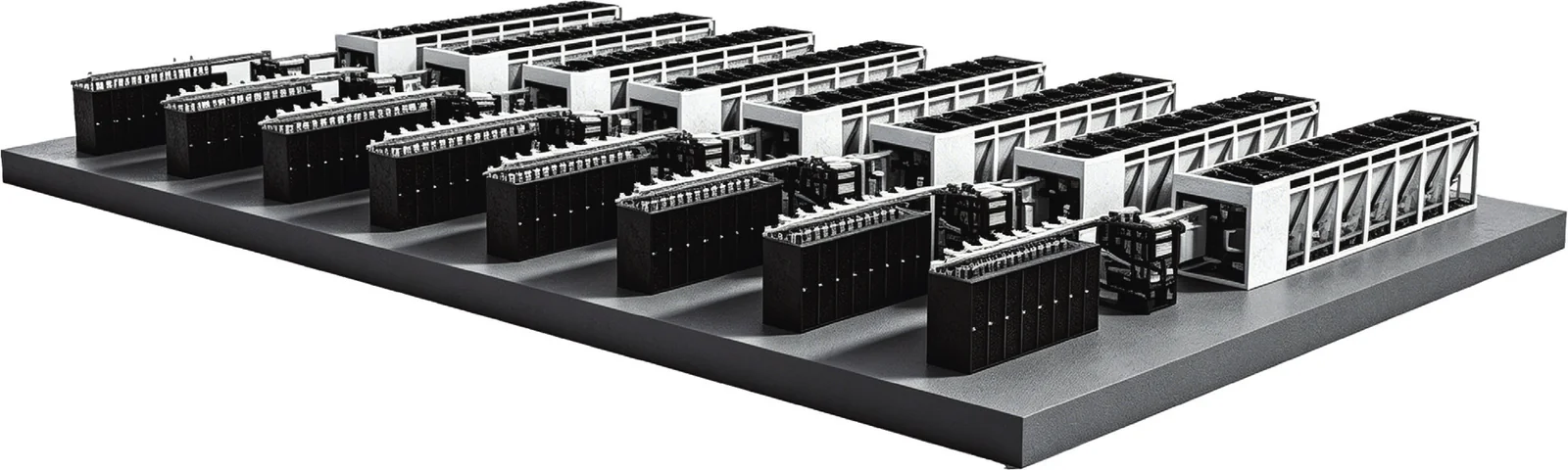
From 6 kW in-rack units to 2,000 kW in-row units, plus dry coolers and pump skids, engineered with the cold plates on one hydraulic budget. Custom CDUs

Cold plates for grid-scale BESS cabinets. BESS liquid cooling

Cold plates for IGBT and SiC modules in inverters and power conversion systems. Power electronics cooling
New Zealand is moving from enterprise and colocation data centres to AI-scale compute. A 280 MW AI data centre campus in Southland received resource consent in March 2026, and further hyperscale and AI projects are in planning. GPU racks built on GB300 and GB200-class platforms run at densities that air cooling cannot handle efficiently, so direct-to-chip liquid cooling becomes the default design choice.
New Zealand’s cool climate suits warm-water liquid cooling. With supply temperatures in the ASHRAE warm-water classes, dry coolers can reject heat for most or all of the year without chillers or evaporative cooling towers, which matters where freshwater use is a community concern. Closed-loop direct-to-chip cooling recirculates the same coolant rather than consuming water.
An AI data centre in New Zealand needs direct-to-chip cold plates on every GPU and CPU, a closed coolant loop sized for warm-water supply, and heat rejection matched to a cool, low-water site. ToneCooling Australia supplies standard GB300 4G+2C and GB200 cold plate kits with published datasheets, plus custom cold plates and CDUs for other platforms.
| Design factor | New Zealand context | What it means for the cold plate loop |
|---|---|---|
| Rack density | AI racks on GB300 and GB200-class platforms | Direct-to-chip cold plates on GPUs and CPUs; air handles only the residual heat |
| Climate | Cool to mild across most sites, coolest in the south | Warm-water supply lets dry coolers do most of the work, with fewer chiller hours |
| Water | Freshwater use is under public scrutiny | Closed-loop cold plates recirculate coolant; no evaporative make-up water at the rack |
| Electricity | 85.5 % of electricity came from renewable sources in 2024 (MBIE) | Cooling energy is still a direct cost; lower pump and fan power per kilowatt of IT load keeps PUE down |
| Supply and documentation | Equipment is imported | ToneCooling Australia Pty Ltd quotes and coordinates supply, with datasheets and AS/NZS-aligned documentation |
4 GPU + 2 CPU cold plates (TC-BZP-GB300-01A). Tested: GPU plate 0.0130–0.0133 °C/W at 1066.94 W, 1.7 L/min, 12.06 kPa; CPU plate 0.0220 °C/W at 485.46 W.
TC-BZP-GB200-01A for 1,200 + 1,200 + 300 W. T2 copper, nitrogen-protected brazing + laser welding; 2.5 L/min, 35 ± 5 kPa, 0.6 MPa.
8 GPU + 4 NVSwitch, 6.344 kW total heat load; 10 LPM recommended flow, 40 kPa maximum pressure drop, 1 MPa.
8 GPU + 4 NVSwitch, 6.344 kW total heat load; 9 LPM, 40 kPa maximum pressure drop, 1 MPa.
These four are standard kits supplied to their datasheets. Cold plates for other GPU and CPU platforms are custom-built and quoted per programme.
Grid-scale batteries are now part of New Zealand’s electricity system. According to the Electricity Authority, three grid-scale batteries are operating (35 MW/35 MWh, 100 MW/200 MWh and 100 MW/200 MWh), a further 100 MW/200 MWh battery at Huntly is due to commission, and more capacity is in the development pipeline. The Authority is also consulting on market and quality arrangements for battery energy storage systems.
Grid batteries that trade energy and provide reserves cycle hard, and cell temperature uniformity drives their service life. Liquid cold plates hold cell-to-cell temperature differences tighter than air cooling at the same discharge rate.
| Step | What happens |
|---|---|
| 1. RFQ | Send heat loads, platform or module type, coolant, and site conditions. The Carlton team confirms receipt and the next steps. |
| 2. Engineering response | Thermal and hydraulic proposal with process recommendation and draft quote, reviewed by the Huizhou design team. |
| 3. NDA and DFM review | Joint design review before any confidential drawings are exchanged. |
| 4. Prototype and validation | Helium leak, pressure and flow testing with lot-traceable records. |
| 5. Delivery | Shipped from Huizhou to the New Zealand site; commercial terms and currency agreed at quotation. |
Many of the standards our documentation references are joint Australian and New Zealand standards, so the same compliance pack serves both markets. Cold plate documentation covers leak tightness, pressure testing, thermal cycling and material declarations. For CDUs, which are electrical equipment, the electrical safety pathway is confirmed per project at quotation, including EESS registration where the equipment is in scope. See our AS/NZS standards reference.

Yes. ToneCooling Australia Pty Ltd handles New Zealand enquiries, quotations and project coordination, with engineering support from Carlton, Victoria.
Our Carlton team works AEST/AEDT business hours, which overlap most of the New Zealand working day.
Yes. We engineer cold plates, manifolds and CDUs together, so the pressure drop and flow for the whole rack are validated as one system.
Yes. We supply cold plates for grid-scale battery cabinets and for IGBT and SiC modules in inverters and power conversion systems.
Yes. New Zealand’s cool climate suits warm-water direct-to-chip cooling: dry coolers can reject heat for most of the year, and a closed coolant loop avoids evaporative water use at the rack.
Yes. The GB300 4G+2C kit and the GB200 kit are standard kits supplied to their datasheets, with a typical sample lead time of 6–8 weeks. Cold plates for other platforms are custom-built and quoted per programme.
Heat load per device or cell, platform or module type, target pressure drop and flow, coolant, site conditions and the qualification documents you need. Use our RFQ input checklist.
Send your design brief to the Carlton team and receive an engineering response with a thermal and hydraulic proposal.
Send a New Zealand RFQRelated for New Zealand projects