Custom thermal components · Australia & New Zealand
Custom LED Heat Sinks for Stage Lighting & Projectors
Specify cooling around the light engine, lens clearance and fan operating point. We review ring-fin and heat-pipe constructions for lighting OEMs and projector developers supplying Australia and New Zealand.
Custom component supply. Configuration and acceptance criteria are agreed against your drawing.
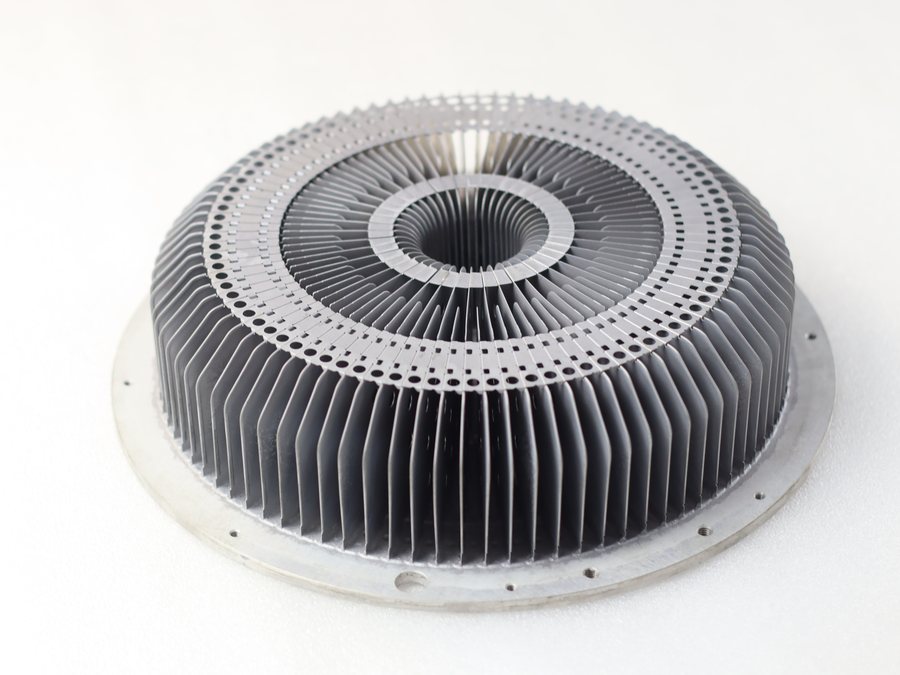
Ring-fin construction reference from the ToneCooling catalogue. The opening, mounting pattern and fin geometry must be checked against your optical assembly.
What determines the right LED heat sink?
Start with the heat entering the base, the allowable base temperature and the air temperature at the heat sink inlet. Then check available airflow, optical clearance, weight and orientation. The lamp’s electrical wattage alone does not establish the required heat-sink performance.
Choose the construction around the fixture
Construction to review
Where it may fit
What decides suitability
Ring-fin geometry
A light engine arranged around an optical opening.
Lens keep-out diameter, base contact area, fan position and the actual air path through the fins.
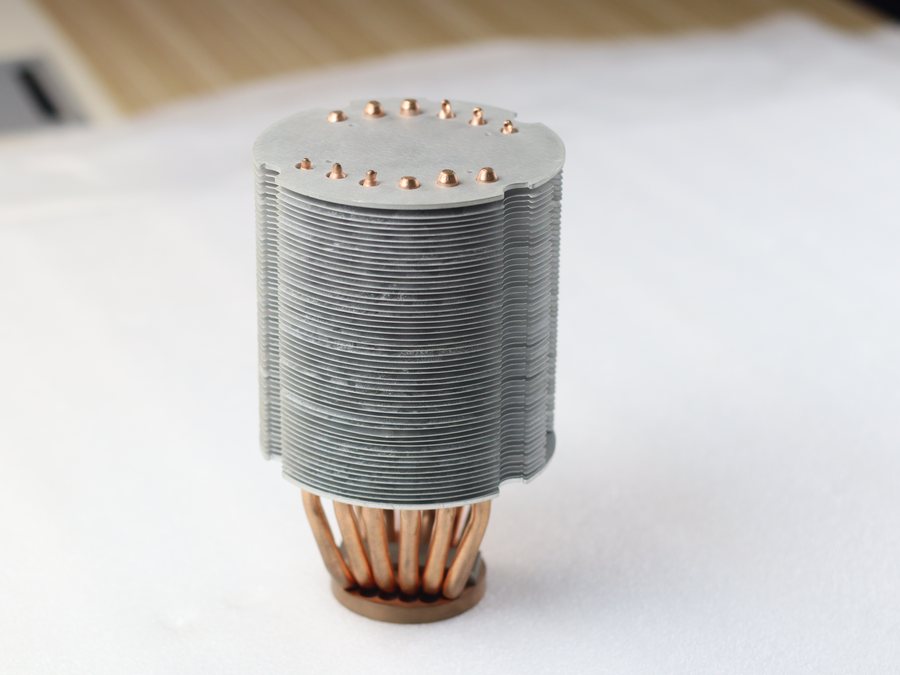
Cylindrical heat-pipe assembly
A concentrated source with space to distribute heat along a taller fin stack.
Source footprint, heat-pipe routing, gravity orientation, stack height and service access.
A drawing-specific alternative
A shallow projector or a fixture that cannot accept either reference geometry.
Envelope, mounting loads and airflow boundary must be reviewed before a construction is proposed.
Cylindrical heat-pipe reference. This image does not establish a heat-load rating, pipe specification or orientation-independent performance.
Keep the airflow path in the drawing
A fan’s free-air flow does not describe its operating point inside a fixture. Share the fan curve, grille and filter restrictions, nearby optical parts and the inlet/outlet arrangement. Recirculated discharge air raises the inlet temperature even when the room temperature is unchanged.
For moving-head and touring fixtures, state the operating orientations and handling loads. For theatre installations, define the quiet operating mode as well as full-output operation.
Translate the thermal target into a testable requirement
For an initial steady-state estimate, the available sink-to-air resistance is Rθ ≤ (Tbase,max − Tair,in) / Qsink. Use the heat actually entering the sink, not the luminaire nameplate power. If the temperature limit is at the LED junction, first allocate the junction-to-case and interface temperature rises; a junction limit cannot be substituted directly for a base limit.
Record the measurement location. A temperature at the base beside an LED is not the same as junction temperature. Define sensor position, TIM, tightening method and the point at which steady state is accepted.
Verify cooling and noise in the assembled fixture
Thermal test
Test the intended light-engine load, inlet temperature and operating orientations. Record base temperature, fan speed and any output derating.
Acoustic test
Agree sound metric, microphone distance, background conditions and operating mode. A bare heat sink has no useful stand-alone fan-noise rating.
Mechanical check
Check optical clearance, balance, fan access and fastener retention. Agree cleaning access and the dust-loading condition used for acceptance.
Drawings and technical documents
For quotation, send the light-engine mounting drawing and fixture envelope. The release package should identify the contact surface, material, finish, included heat pipes or fan hardware, and the agreed thermal and acoustic test method.
Project-specific documentation
No verified model-specific performance datasheet is available for this custom reference. Request a drawing review and agree the technical document package for your configuration.
Construction reference: ToneCooling European product page. Photographs show reference constructions, not a validated configuration for your project. Numerical performance will only be stated with its source and test conditions.
Drawing-led enquiry
Request an LED heat-sink quotation
Specify whether you need the heat sink alone or an assembly with heat pipes, brackets, TIM or fans. List each supplied item; luminaire wiring, controls and final product approval are separate unless expressly included.
Opens an editable email checklist; nothing is sent automatically. Attach your drawings before sending. NDA arrangements can be agreed before you share confidential files.
Include these project inputs
Light-engine loss and contact footprint
Maximum base temperature and sensor position
Inlet air temperature, fan curve and restrictions
Optical keep-outs, envelope and mass limit
Operating orientations and acoustic acceptance
ToneCooling Australia Pty Ltd coordinates Australian and New Zealand enquiries; manufacturing is in Huizhou, Guangdong, China. Include the destination postcode and required delivery date. Currency, freight, lead time and included inspection documents are confirmed in the quotation.
Engineering questions
Can one heat sink be used across several LED power versions?
Possibly, but each version needs a loss map and temperature check. A higher-power light engine can also change source concentration and the required interface, not just total watts.
Does black anodising guarantee better cooling?
No. Surface finish can affect radiation and contact or electrical requirements, while airflow and geometry remain important. Specify cosmetic, corrosion and contact requirements and test the selected finish.
Can you quote without a final fan?
An initial scope review is possible, but airflow-dependent performance remains provisional. Supply candidate fan curves and enclosure restrictions so the assumptions can be recorded.