Custom thermal components · Australia & New Zealand
DC Fast Charger Cold Plates for Power Modules
Build a cooling specification around the converter loss map, module contacts and cabinet coolant circuit. Custom cold plates support charging-equipment development for Australia and New Zealand; the construction is selected against your module drawing.
Custom component supply. Configuration and acceptance criteria are agreed against your drawing.
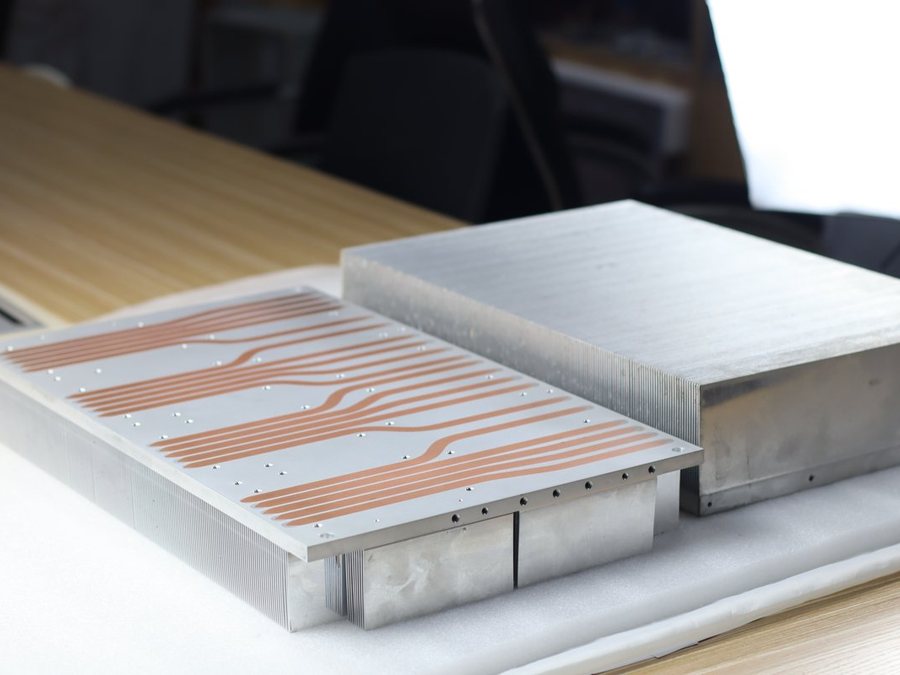
Power-electronics construction reference: a tube path combined with a finned base. This is not a qualified charger assembly. Any contribution from the fins depends on the installed airflow.
How much heat must a charger cold plate remove?
Use the losses assigned to the cooled devices at each operating condition. Charger output power is electrical energy delivered to the vehicle; it is not the cold-plate heat load. Identify the share removed by coolant, cabinet air and other paths.
Turn the electrical loss map into a cooling drawing
Design input
Provide for the RFQ
Why it changes the cold plate
Switching devices
Loss by module at the agreed voltage, current, switching mode and temperature.
Two converters with the same output can have different losses and local heat flux.
Contact surfaces
Module footprint, screw pattern, TIM, flatness and allowable assembly force.
Contact resistance and load distribution influence the hottest module.
Coolant boundary
Fluid product, concentration, minimum and maximum inlet temperatures, available flow.
Viscosity and heat capacity change with fluid and temperature; a water result may not transfer.
Cabinet integration
Plate envelope, hose access, pump curve, mounting direction and air path.
The plate must fit the real system and remain accessible for maintenance.
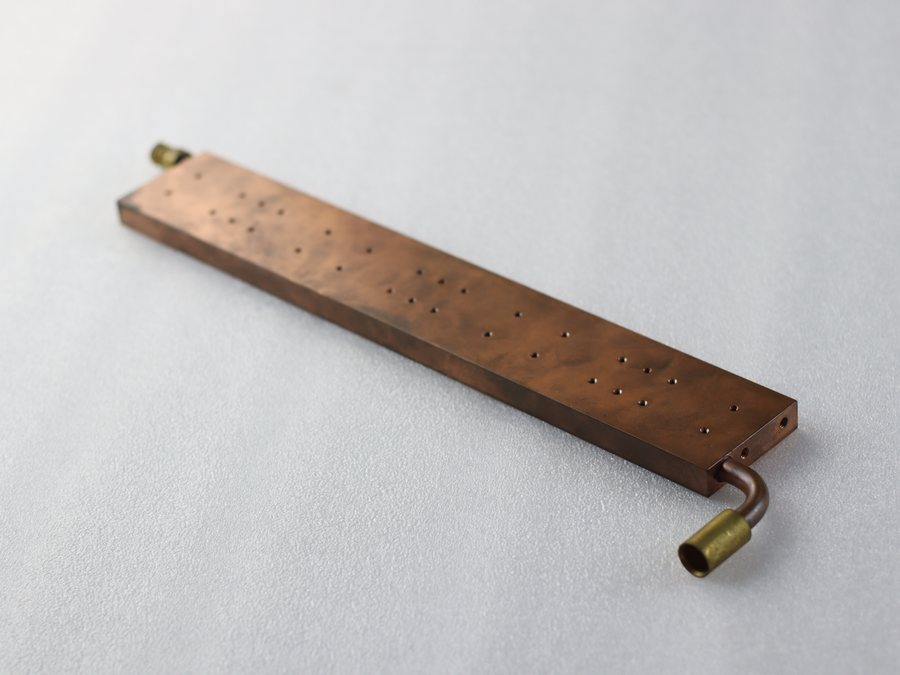
Tube-and-contact-bar reference. Wetted materials, tube-to-bar attachment and module mounting must be specified; the photograph does not establish a pressure rating.
Compare a simple tube route with a distributed channel design
A tube route can suit a linear module arrangement when the contact bar spreads heat into the tube effectively. Check the interface between the tube and surrounding structure as part of the thermal path.
A distributed channel design may be reviewed when several concentrated heat sources need local cooling. It requires its own channel, joining, cleanliness and pressure-boundary specification. Do not infer internal geometry from the external reference images.
Set the Australian or New Zealand installation conditions
For a roadside cabinet, define coolant temperature after the external heat-rejection stage at the intended site. Ambient air temperature alone is not the cold-plate inlet temperature. Identify solar exposure, inlet-air recirculation, filter loading and any reduced-output operating mode.
For an alpine, inland or coastal location, specify the actual freeze-protection, corrosion and maintenance requirements. These are site inputs, not a single national design temperature. Include the installation city, service access and spare-module strategy in the enquiry.
Keep electrical safety responsibilities explicit. Agree which component provides dielectric isolation and which surfaces are grounded. A coating description or cold-plate pressure test does not establish charger-level electrical compliance.
Accept the plate under a defined converter duty
Thermal distribution
Use the agreed module loss map and sensor locations. Check the hottest contact area at the limiting coolant condition, rather than averaging every module temperature.
Hydraulic and leak tests
Define pressure drop between named ports at a stated fluid temperature. Agree operating, proof and leak-test conditions separately, including medium, duration and allowable leakage.
Assembly and isolation
Verify module seating, TIM thickness, tightening sequence, contact clearances and port access. The charger integrator owns the complete electrical acceptance unless the contract states otherwise.
Request the drawing and acceptance package
Request a plate drawing with module datums, contact tolerances, port details and material definitions. Agree the flow/pressure-drop record, thermal test boundary and inspection documentation before prototype manufacture.
Configuration-specific documents
No verified model-specific performance PDF is available for this reference. The button requests a drawing and specification review; it is not a datasheet download.
Construction reference: ToneCooling catalogue page. Reference images do not establish performance or qualification. The accepted drawing revision and agreed test conditions define the supplied component.
Drawing-led enquiry
Request a charger cold-plate quotation
Quote the cold plate and list any included fittings, insulation, TIM or mounting hardware. Cabinet heat rejection, charger electronics, charging cables and site installation are separate scopes unless listed in the offer.
Opens an editable email checklist; nothing is sent automatically. Attach your drawings before sending. NDA arrangements can be agreed before you share confidential files.
Include these project inputs
Converter loss map and operating cases
Module drawing, TIM and electrical isolation boundary
Coolant product, concentration and inlet-temperature range
Required flow, pressure-drop budget and working pressure
Cabinet envelope, site location and prototype acceptance
ToneCooling Australia Pty Ltd coordinates Australian and New Zealand enquiries; manufacturing is in Huizhou, Guangdong, China. Include the destination postcode and required delivery date. Currency, freight, lead time and included inspection documents are confirmed in the quotation.
Engineering questions
Can the charger efficiency estimate be used for an initial enquiry?
It can support a preliminary heat balance if its operating point is stated. It does not show where heat is generated or how much enters this plate. Provide a component loss map before committing to a thermal acceptance target.
Does an embedded copper tube require a copper-only loop?
Not necessarily. Review every wetted material, coolant chemistry, inhibitor package and maintenance requirement together. The material visible on the outside may not be the complete wetted-material list.
Can the cold plate be selected before the cabinet radiator?
A preliminary design can use an agreed inlet-temperature envelope. Final acceptance needs compatible radiator, pump and coolant conditions; changing the cabinet heat-rejection stage can change that envelope.