
Server Optical Module · T-HS202331
Optical Module Liquid Cold Plate for Australia
ToneCooling Australia supplies copper liquid cold plates for high-density server optical modules (400G/800G transceivers) — model T-HS202331, 16 × 25 W positions on one ultrasonic-welded thin plate. Design, engineering and manufacturing at our IATF 16949-aligned facility in Huizhou; customer engineering support from Carlton, Victoria.
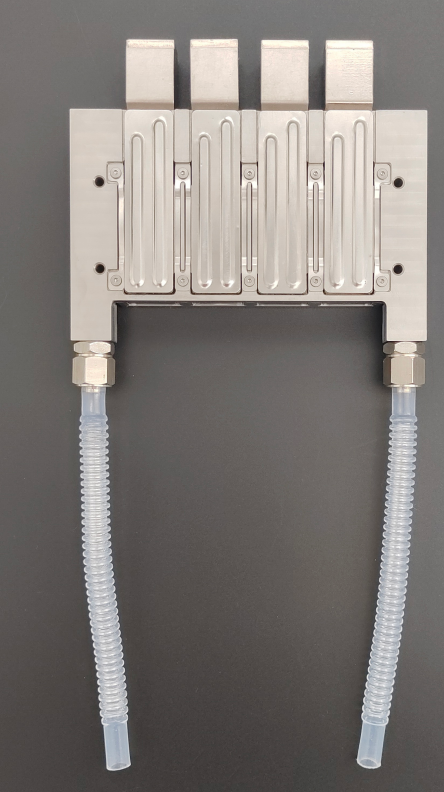
ToneCooling Australia manufactures copper liquid cold plates for server optical module racks (400G/800G transceivers) — a single 416×122×8mm ultrasonic-welded plate cooling 16 positions at 25 W each, tested to 100% helium leak criteria. Manufacturing is in Huizhou, Guangdong, China.
Validated specifications
| Heat dissipation | 25 W × 16 positions |
|---|---|
| Cold plate material | Copper |
| Joining process | Ultrasonic welding |
| Coolant / medium | 25% PGW (propylene glycol-water) |
| Feed liquid temperature | 40°C inlet |
| Cold-plate surface temperature | ≤52°C at rated load |
| Flow rate / pressure drop | 1.2 LPM at 7.9 kPa |
| Maximum working pressure | 0.6 MPa |
| Dimensions | 416 × 122 × 8 mm |
Related cold plates
Frequently asked questions
Do you supply liquid cold plates for server optical modules?
Yes. ToneCooling Australia supplies a copper liquid cold plate (model T-HS202331) sized for 16 x 25W server optical-transceiver positions on one ultrasonic-welded thin plate, for 400G/800G optical networking racks.
Why is this plate only 8mm thick?
Optical module cages sit in a tight 1U/2U pitch, so the cold plate is engineered as a thin (8mm) ultrasonic-welded plate to fit the same envelope as the transceiver cage row without redesigning the chassis.
What coolant and flow rate does it use?
Rated performance is tested with 25% PGW coolant at 40°C inlet, 1.2 LPM flow rate at approximately 7.9 kPa pressure drop, holding position temperature at or below 52°C.
Can the position count or pitch be customised?
Yes. Position count, pitch, port location and mounting pattern are engineered from your transceiver-cage drawing, with CFD validating flow balance across all positions before tooling.
What is the Quantity and lead time?
Prototype orders start from 1 piece with a 4–6 week prototype lead time from approved drawing and purchase order; production lead time is confirmed per volume.
How is quality verified before shipment to Australia?
Every unit is 100% helium leak tested, with flatness and dimensional checks against the acceptance criteria agreed in writing before quotation.
Request an optical module cold plate quote
Send your transceiver-cage layout, position count and heat map. Our Carlton team responds with a DFM review and quotation.
Request a Quote