
TC-DCU-2000
Download TC-DCU-2000 PDFFree PDF · no form required.
Compare five TC-DCU catalogue references for outdoor heat rejection. For AU/NZ projects, start with the installation climate, fluid circuit and available space, then request a condition-specific selection.
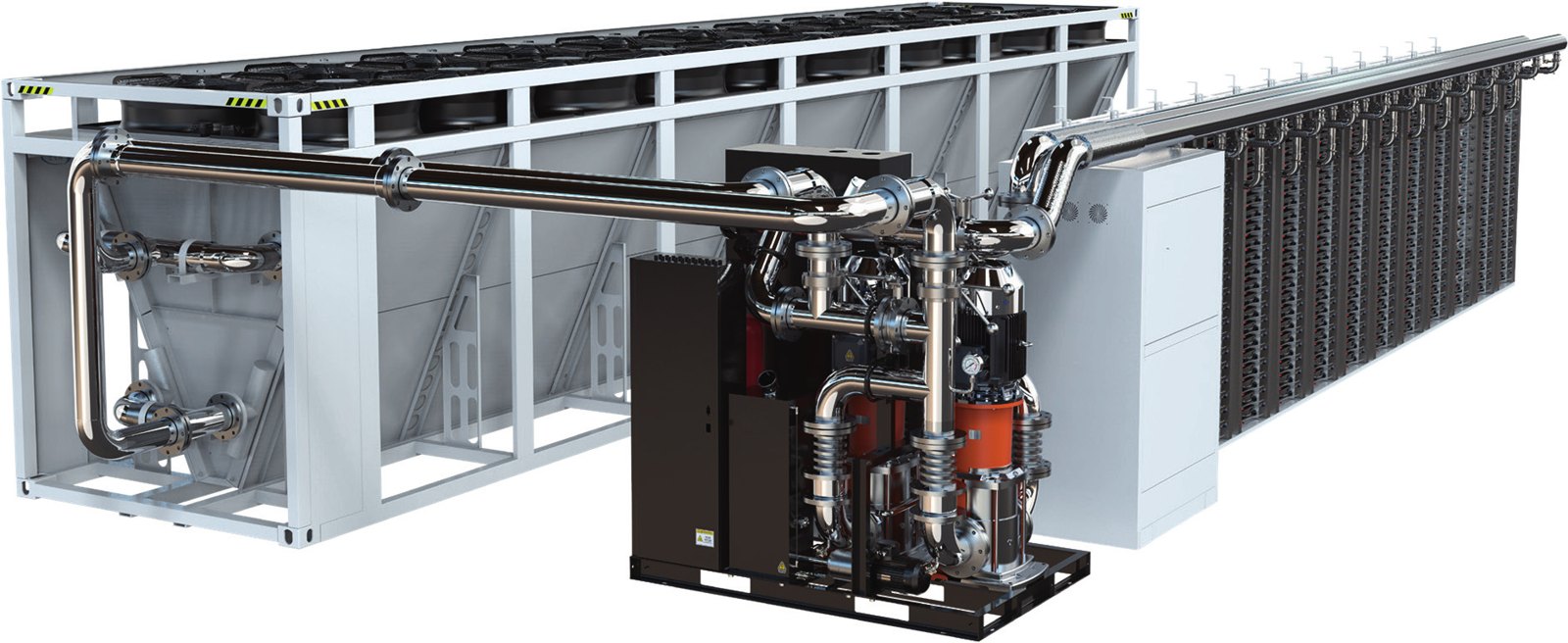
An integrated dry cooling unit rejects heat from a liquid circuit to outdoor air. Its achievable duty depends on entering air temperature, fluid temperatures, mixture and airflow. Select against the site design condition rather than treating the model number as a constant all-weather rating.
Free PDF · no form required.
Free PDF · no form required.
Free PDF · no form required.
Free PDF · no form required.
Free PDF · no form required.
| Model | Catalogue load | Flow reference | Envelope |
|---|---|---|---|
| TC-DCU-2000 | 2000 kW | 5000 L/min | 13300 × 2280 × 2535 mm |
| TC-DCU-1600 | 1600 kW | 4000 L/min | 13300 × 2280 × 2535 mm |
| TC-DCU-1000 | 1000 kW | 3200 L/min | 6600 × 2280 × 2535 mm |
| TC-DCU-600 | 600 kW | 2000 L/min | 6600 × 2280 × 2535 mm |
| TC-DCU-300 | 300 kW | 1000 L/min | 3300 × 2280 × 2535 mm |
Source: linked ToneCooling model datasheets. Catalogue values are references, not independently verified performance or a guarantee that every listed value applies at one simultaneous duty point. Confirm fluid, temperature, external pressure, electrical configuration, dimensions and mass basis in the accepted selection.
Specify the outdoor design dry-bulb temperature at the actual intake. Nearby walls, adjacent units and hot-air recirculation can change the air reaching the coil. Provide a roof or ground-level layout with clearances, obstructions and the proposed service route.
Record coolant supply and return requirements, mixture, freezing exposure and the accepted temperature excursions. A dry cooler is not a refrigerant chiller; do not assume it can deliver coolant below entering-air temperature. Adiabatic operation is not included unless explicitly offered for the selected configuration.
| Selection item | Input or reference | Required confirmation |
|---|---|---|
| Thermal selection | Site air temperature, coolant temperatures, mixture and required duty. | Request a selection at the stated coincident conditions. |
| Outdoor location | Coastal exposure, wind, dust, recirculation and access. | Agree materials, coating, mounting and maintenance provisions. |
| Acoustics | Required sound metric, assessment location and night operating case. | Obtain data for the selected fan/control arrangement. |
| Transport and services | Largest section, lifting route, base loads and electrical connection. | Confirm delivered sections and site assembly responsibilities. |
List the CDU or skid, connections, sensors, controls and accessories included in the offer. Allocate installation, water treatment, flushing, filling, electrical connection and commissioning to named project parties. Australian or New Zealand enquiry support does not imply local stock, on-site installation or an included service contract.
Request the controlled drawing, selected duty, component schedule and agreed factory test records. Confirm site electrical requirements and applicable conformity documentation for the offered configuration; a catalogue voltage or a pump arrangement is not proof of project compliance or redundancy.
Send the following conditions for a configuration-specific offer. Capacity, included equipment, documents, delivery terms and installation responsibilities must be confirmed in writing.
Prepare my enquiry by emailOpens an editable email checklist; nothing is sent automatically. Attach your drawings before sending. NDA arrangements can be agreed before you share confidential files.
ToneCooling Australia Pty Ltd coordinates Australian and New Zealand enquiries; manufacturing is in Huizhou, Guangdong, China. Include the destination postcode and required delivery date. Currency, freight, lead time and included inspection documents are confirmed in the quotation.
No. A condition-specific selection is required. Higher entering-air temperature can reduce the available temperature difference and heat-rejection duty.