
Resource · Data Centre Liquid Cooling
Data Centre Water Use in Australia: How Much Does AI Cooling Need?
Data centre water use is becoming a planning constraint for AI data centres in Sydney and other drought-exposed regions. The cooling architecture you choose largely decides how much of it your site consumes. This guide explains how data centre water consumption is measured, where it comes from, and how closed-loop direct-to-chip cooling with dry coolers keeps it low under Australian conditions.
Section 1 of 5
Why is data centre water use now a constraint in Australia?
Sydney Water reports that data centres use about 3.5 billion litres of Sydney's drinking water a year, less than 1 per cent of demand, but forecasts they could use the equivalent of a quarter of the city's current annual supply by 2035 as AI capacity grows.
The same forecast notes that data centres in Macquarie Park alone could draw up to 30 megalitres a day within a decade, about 2 per cent of Sydney's current daily drinking water demand (ABC News, August 2025).
Policy is moving the same way. In September 2026 the federal government said it intends to legislate standards for AI data centres by early 2027, including a requirement that they be as water-efficient as possible and built in appropriate locations (ABC News, September 2026). Detailed thresholds have not yet been published, so new projects are designing for low water use now rather than waiting for the rules.
Section 2 of 5
How is data centre water consumption measured?
The standard metric is Water Usage Effectiveness (WUE), defined by The Green Grid as annual site water usage in litres divided by IT equipment energy in kilowatt-hours (L/kWh). Lower is better.
WUE lets operators compare sites of different sizes and shows the effect of cooling design choices directly (The Green Grid, White Paper #35). Most of a data centre's direct water use comes from one place: evaporative heat rejection, where cooling towers evaporate water to shed heat to the atmosphere.
Section 3 of 5
Do water-cooled data centres use water in a closed loop?
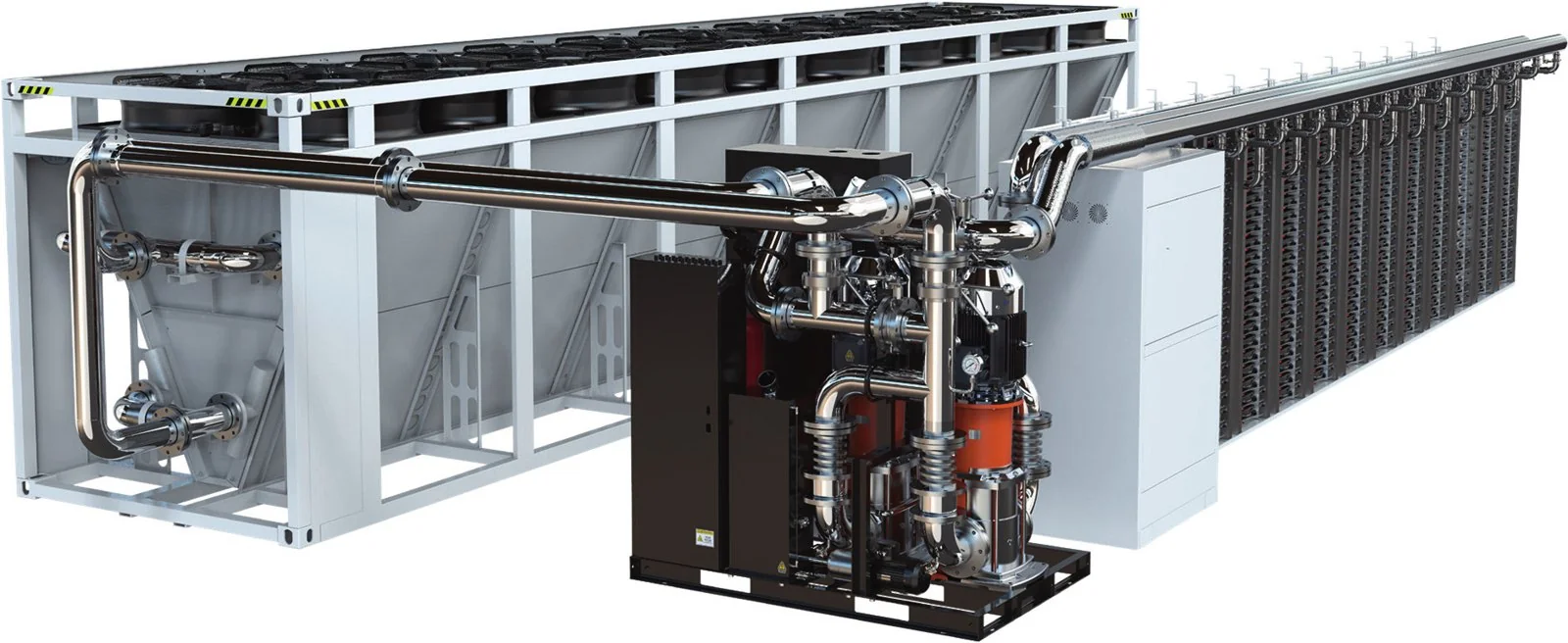
The coolant loop through the cold plates is sealed and is not consumed. Whether the site uses water depends on how that heat is finally rejected: evaporative cooling towers consume water, dry coolers do not.
| Heat rejection method | Evaporative water use | Best fit |
|---|---|---|
| Evaporative cooling tower | High; rises with heat load and ambient temperature | Sites with secure water supply and low-temperature loops |
| Hybrid dry cooler with adiabatic assist | Low; water used only on peak days | Hot sites that need peak-day margin |
| Dry cooler | None in normal operation | Warm-water liquid cooling loops in water-constrained regions |
Direct-to-chip cooling makes dry coolers practical because it captures heat at the processor, at a much higher temperature than room air. A warmer coolant loop can reject heat to ambient air for more hours of the year without evaporation.
Section 4 of 5
How do you design a low-water liquid cooling system for Australian heat?
Design the loop warm, size the cold plates for that warm inlet, and engineer the cold plates, CDU and dry cooler on one hydraulic budget.
1. Choose a warm-water class
The ASHRAE W32 and W40 facility water classes published by ASHRAE TC 9.9 allow higher supply temperatures, which extends the hours dry coolers can carry the full load.
2. Size the cold plate for the warm inlet
A warmer inlet leaves less margin to the processor's case temperature limit, so channel design and flow are checked against the site's hottest design day, not a generic 25 °C assumption.
3. Plan for peak days at inland sites
Summer peaks above 45 °C occur at inland and northern Australian sites. A hybrid dry cooler with adiabatic assist on the hottest days keeps annual water use low without over-sizing the plant.
4. Use one hydraulic budget
Pump head, manifold and quick-disconnect losses and cold plate pressure drop are calculated on one model, so every GPU receives its design flow at the warm inlet temperature.
Liquid cooling kits and related pages
GB300 4 GPU + 2 CPU cold plate kit
Batch-validated: 1,066.94 W GPU load at 1.7 L/min, 12.06 kPa.
GB200 cold plate kit
2,700 W copper cold plate set for GB200-class platforms.
Dry coolers
Closed-loop heat rejection without evaporative water use.
Custom CDUs
In-rack and in-row CDUs engineered with the cold plates.
AI server liquid cooling
Direct-to-chip cold plates for GB200, GB300 and H200.
New Zealand
Cold plates and CDUs for New Zealand data centres.
Section 5 of 5
Frequently asked questions
How much water do data centres use in Sydney today?
Sydney Water has reported that data centres use about 3.5 billion litres of Sydney's drinking water a year, less than 1 per cent of total demand, but forecasts that data centres could use the equivalent of a quarter of Sydney's current annual supply by 2035.
What is Water Usage Effectiveness (WUE)?
WUE is a metric defined by The Green Grid: annual site water usage in litres divided by IT equipment energy in kilowatt-hours. A lower WUE means less water per unit of computing.
Do data centres use water in a closed loop?
The liquid cooling loop that runs through the cold plates and CDU is a closed loop: the same coolant recirculates and is not consumed. Water is consumed only at the heat rejection stage if evaporative cooling towers are used. With dry coolers, the whole system can run without evaporative water use in normal operation.
Does direct-to-chip liquid cooling use water?
The coolant loop that runs through the cold plates is closed and is not consumed. Water is consumed only if the heat is finally rejected through evaporative cooling towers. Rejecting heat through dry coolers instead removes most evaporative water use.
Can Australian sites run dry coolers all year?
It depends on the site climate and the coolant temperature the IT equipment accepts. Designing the loop for warm-water operation, within the ASHRAE W32 or W40 classes, lets dry coolers reject heat for more hours of the year. Hot inland sites may still need trim cooling on peak days.
Does ToneCooling supply the CDU and dry cooler as well as the cold plates?
Yes. ToneCooling engineers cold plates, manifolds, custom CDUs and dry cooler pump skids on one hydraulic budget, manufactured at our own manufacturing facility in Huizhou, with engineering support from Carlton, Victoria. Cold plate prototype lead time is typically 6–8 weeks.
Sources: Sydney Water forecasts as reported by ABC News (27 August 2025); federal data centre policy as reported by ABC News (11 September 2026); The Green Grid White Paper #35 (WUE); ASHRAE TC 9.9 liquid cooling guidelines. Last reviewed: 29 September 2026.
Planning to cut data centre water use in Australia or New Zealand?
Send your rack density, site location and target coolant temperature. Our Carlton team will coordinate a cold plate, CDU and dry cooler proposal on one hydraulic budget.
Request an Engineering Review