
FSW vs Vacuum Brazed Cold Plate
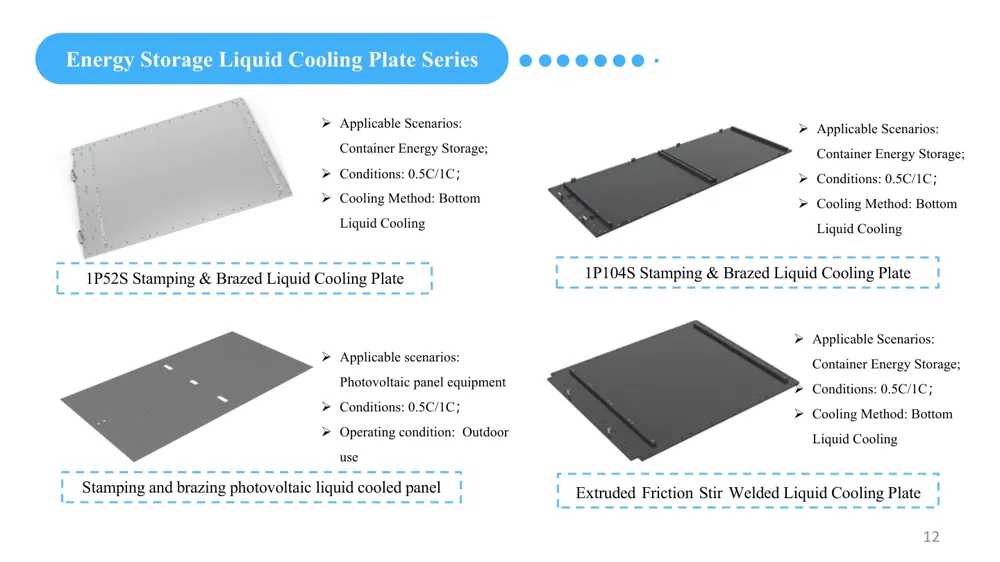
| Dimension | FSW (friction stir welding) | Vacuum brazing |
|---|---|---|
| Joining | Solid-state weld (no filler/melting) | Furnace-brazed with filler alloy |
| Typical material | Aluminium (6061/6063) | Copper (C1100) or aluminium |
| Channel type | Buried machined channels | Internal fins / microchannels |
| Leak integrity | Strong, leak-tight buried joints | 100% helium-leak verified |
| Best heat flux | Moderate (large-area plates) | High (dense GPU/CPU dies) |
| Typical use | EV battery, BESS, large low-pressure plates | AI GPU/CPU direct-to-chip, power electronics |
| Cost at volume | Cost-effective for large Al plates | Higher; suits high-performance Cu plates |
Choosing FSW vs vacuum brazing
Friction stir welding (FSW) is a solid-state process ideal for large aluminium cold plates with buried channels — common in EV battery, BESS and lower-pressure applications. Vacuum brazing furnace-bonds internal fin or microchannel structures (often copper) for high heat-flux GPU/CPU and power-electronics cold plates. The right choice depends on material, heat flux, pressure and volume.
ToneCooling offers FSW, vacuum brazing and TLP
ToneCooling provides FSW, vacuum brazing, controlled-atmosphere brazing and its proprietary TLP diffusion bonding — so the joining process is matched to your application, not to a single in-house capability. All processes run at our IATF 16949-aligned facility in Huizhou, China, with Australian customer engineering support from Carlton.
Which suits your Australian programme?
For AU EV/BESS aluminium plates, FSW is often the cost-effective route; for AI-server GPU/CPU or IGBT power-electronics cold plates, vacuum brazing delivers the high heat-flux performance. See our BESS, GPU and TLP diffusion bonding pages.
Frequently asked questions
What is the difference between FSW and vacuum brazed cold plates?
FSW (friction stir welding) is a solid-state weld used mainly for aluminium plates with buried channels; vacuum brazing furnace-bonds internal fins or microchannels (often copper) for high heat-flux cooling. FSW suits large EV/BESS plates; vacuum brazing suits dense GPU/CPU cold plates.
Which process is better for EV and BESS cold plates?
Friction stir welding is often preferred for large aluminium EV and BESS cold plates — it gives strong, leak-tight buried channels cost-effectively at volume.
Which process is better for AI GPU/CPU cold plates?
Vacuum brazing is preferred for high heat-flux AI GPU/CPU cold plates, where dense internal copper fin or microchannel structures are needed.
What is TLP diffusion bonding?
TLP (transient liquid phase) diffusion bonding is ToneCooling's proprietary joining process. It forms a continuous metallurgical joint without a filler-metal interface and suits copper cold plates that see heavy thermal cycling.
Does ToneCooling offer all these processes?
Yes. ToneCooling provides FSW, vacuum brazing, controlled-atmosphere brazing and TLP diffusion bonding, selecting the process per application — with Australian customer engineering support from Carlton, Victoria.
Discuss your BESS thermal design
Send your module layout, cell format, and AS/NZS scope to the Carlton customer engineering support team — an engineer reviews every RFQ and replies by email with next steps.
Request a Quote