
Solution · Data Centre · Australia & New Zealand
Direct-to-Chip Cooling Suppliers in Australia and New Zealand
Direct-to-chip cooling suppliers provide the cold plates, manifolds, quick disconnects and coolant distribution units (CDUs) that move processor heat into a closed liquid loop instead of room air. ToneCooling Australia is a direct-to-chip liquid cooling supplier for Australian and New Zealand data centres: standard GB300 4G+2C, GB200, H200 and H100 kits supplied to their datasheets, and custom cold plates for other platforms. Cold plates are made in our own manufacturing facility in Huizhou, China (IATF 16949-aligned); engineering coordination, documentation and customs support come from Carlton, Victoria.

What do direct-to-chip cooling suppliers provide?
A direct-to-chip cooling supplier provides the hardware between the processor and the facility water loop: cold plates on each GPU and CPU, rack manifolds and quick disconnects, hoses and loop assemblies, a CDU, and heat rejection such as dry coolers. Some suppliers make every part; most make one layer and source the rest, so ask each vendor which parts they manufacture.
| Layer | What it does | ToneCooling Australia scope |
|---|---|---|
| Cold plates | Take heat from each GPU / CPU into the coolant | Made in our own manufacturing facility in Huizhou, China. Standard: GB300 4G+2C, GB200, H200, H100. Other platforms: custom cold plates |
| Rack manifolds, quick disconnects, hoses | Distribute coolant to every tray and allow hot-swap | Manifolds and quick disconnects supplied by ToneCooling from China, configured to order |
| Loop assemblies | Connect cold plates inside the server tray | Server loop assemblies, scope agreed per project |
| CDU | Pumps and filters the secondary loop and exchanges heat with facility water | In-rack and in-row CDUs supplied by ToneCooling from China; electrical safety pathway confirmed per project at quotation |
| Heat rejection | Rejects heat to ambient air or a facility loop | Dry coolers, sized for site peak ambient |
| Engineering | Thermal review, DFM, test reports | DFM review and validation; documentation from Carlton, Victoria |
How do you choose a direct-to-chip liquid cooling vendor?
Choose a direct-to-chip liquid cooling vendor that publishes tested data for your platform with the test conditions, lets you download the datasheet without a form, states which parts it makes itself, leak-tests every cold plate, and can supply a sample before volume. For Australian and New Zealand sites, also check who holds local responsibility for documentation and customs.
| Check | What to ask for | What ToneCooling Australia provides |
|---|---|---|
| Tested data for your platform | Thermal resistance, flow and pressure drop, with test conditions | GB300 GPU plate: 0.0130–0.0133 °C/W at 1,066.94 W, 1.7 L/min, 12.06 kPa (pure water, 2026-03-20 test). GB200 kit: 2.5 L/min, 35 ± 5 kPa (datasheet) |
| Datasheet access | Download without a sales call | GB300, GB200, H200 and H100 datasheets download with no form |
| What the vendor makes | Own factory or reseller, for each layer | Cold plates: our own manufacturing facility in Huizhou, China. CDUs, manifolds, quick disconnects: supplied by ToneCooling from China |
| Leak testing | Test method and acceptance criterion | 100 % helium leak tested; criterion set per project |
| Test reports | Reports you can file with the project | Thermal resistance, leak and flatness reports available |
| Quality system | Process control for volume | IATF 16949-aligned quality system |
| Samples | A sample before volume | Custom samples are available from a single piece; typically 4–6 weeks including design and simulation |
| Volume lead time | Lead time confirmed in writing | Normally 6–8 weeks, confirmed at quotation; CDU samples 8–10 weeks |
| Local entity | Who signs, documents and supports locally | ToneCooling Australia Pty Ltd, ABN 96 653 174 040, Carlton VIC; New Zealand projects handled by the same entity |
| Standard vs custom | Which parts are standard | GB300, GB200, H200, H100 are standard parts; all other platforms are custom designs |
What test data should a direct-to-chip cooling supplier publish?
A supplier should publish heat load, coolant, flow rate, inlet and outlet temperature, pressure drop and thermal resistance for each cold plate, measured under stated conditions. The table below is the steady-state test data from our GB300 4G+2C datasheet (TC-BZP-GB300-01A, pure water, 2026-03-20) and the rated values from the GB200 datasheet (TC-BZP-GB200-01A).
| Item | GB300 GPU plate | GB300 CPU plate | GB200 kit |
|---|---|---|---|
| Heat load | 1,066.94 W (tested) | 485.46 W (tested) | 1,200 + 1,200 + 300 W (2 × GPU + Grace CPU) |
| Coolant and flow | Pure water, 1.7 L/min | Pure water, 0.7 L/min | Pure water 25 ± 2 °C, 2.5 L/min |
| Inlet / outlet | 19.9 / 27.3 °C | 23.6 / 31.5 °C | — |
| Pressure drop | 12.06 kPa | 10.39 kPa | 35 ± 5 kPa |
| Thermal resistance | 0.0130–0.0133 °C/W | 0.0220 °C/W | Confirmed by project CFD |
| Other | Thermal interface TC-5888 | — | T2 copper, nitrogen-protected brazing + laser welding, 0.6 MPa max working pressure |
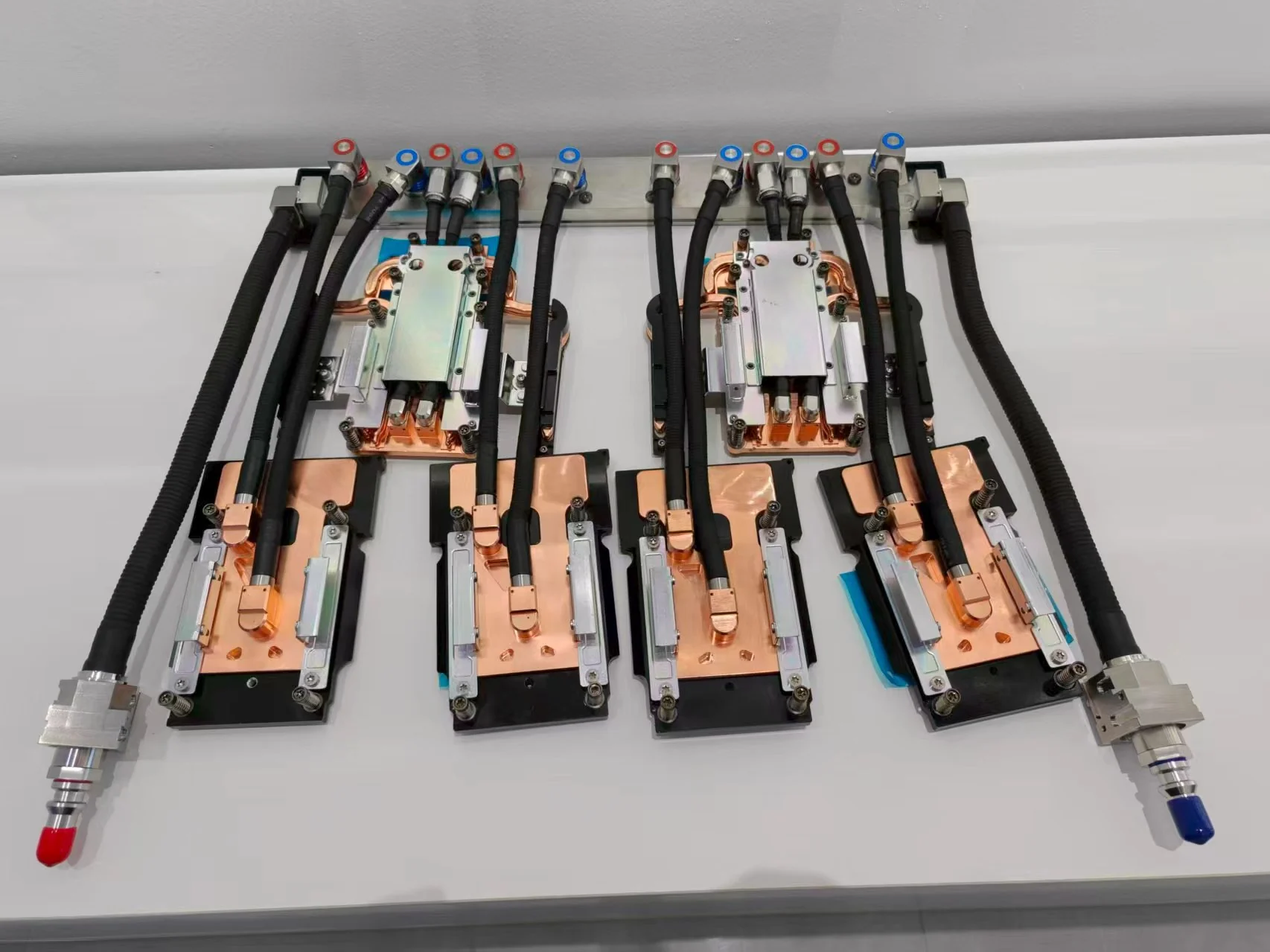
Download the GB300 4G+2C datasheet (PDF) · Download the GB200 datasheet (PDF)
Which liquid cooling companies supply Australian and New Zealand data centres?
Liquid cooling for Australian and New Zealand data centres comes from global cooling OEMs with local offices, local distributors of heat exchangers and fluid components, IT integrators, and specialist cold plate manufacturers. Data centre operators usually buy rack-level hardware through the server vendor or integrator, so a cold plate supplier must fit that chain.
ToneCooling Australia fits as the cold plate and rack-level hardware supplier: we work with the operator, integrator or server builder that runs the site. What is specific to Australian and New Zealand projects:
- Local entity: ToneCooling Australia Pty Ltd (ABN 96 653 174 040) in Carlton, Victoria handles quotation, documentation and customs coordination for Australia and New Zealand.
- Climate: heat rejection has to work on peak days. Penrith Lakes in Western Sydney recorded 48.9 °C in January 2020 (Bureau of Meteorology), so dry coolers and CDU approach temperatures are sized for site peak ambient. See data centre liquid cooling in Sydney.
- Water: closed-loop direct-to-chip cooling recirculates coolant; pairing it with dry coolers keeps site water use low, which matters for water-constrained sites.
- Electrical equipment: for CDUs and other powered equipment, the electrical safety pathway is confirmed per project at quotation.
- Coolant: pure water, PG25 or EGW loops are reviewed per project; see the coolant selection guide.
- New Zealand: the same datasheets and RFQ process apply; see ToneCooling in New Zealand.
For AI server racks specifically, see AI server rack cold plates; for the full system view, see data centre liquid cooling in Australia.
What should an RFQ to a direct-to-chip cooling supplier include?
An RFQ should give the platform and heat load per chip, the number of trays and racks, the coolant and supply temperature, the pressure-drop budget, the quick-disconnect standard, annual volume, project stage and target sample date. With these, a supplier can confirm fit, sample timing and a quotation without guessing.
| Input | Example of what to send |
|---|---|
| Platform | GB300 4G+2C, GB200, H200, H100, or another CPU / GPU (custom) |
| Heat load per chip | W per GPU and per CPU, plus any memory or VRM load to be cold-plated |
| Trays and racks | Trays per rack and number of racks |
| Coolant and supply temperature | Pure water, PG25 or EGW; supply temperature range |
| Pressure-drop budget | Allowed kPa across the cold plate at design flow |
| Connections | Quick-disconnect type and hose routing |
| Volume and stage | Annual volume, project stage, target sample date |
| Drawings | STEP or PDF of the board or keep-out zones, if available |
Use the RFQ input checklist to prepare the brief. Custom samples are available from a single piece.
Direct-to-chip cooling suppliers: FAQ
Who are the direct-to-chip cooling suppliers in Australia?
Direct-to-chip cooling in Australia is supplied by three kinds of companies: global cooling OEMs with local branches, Australian distributors of thermal and fluid components, and cold plate manufacturers that supply racks, CDUs and integrators. ToneCooling Australia Pty Ltd (ABN 96 653 174 040, Carlton VIC) supplies direct-to-chip cold plates made in our own manufacturing facility in Huizhou, China, plus CDUs, manifolds and quick disconnects supplied by ToneCooling from China and configured to order.
Is direct-to-chip cooling the same as direct liquid cooling (DLC)?
Yes, in data centre use the terms are used for the same approach: a cold plate sits on each GPU or CPU and a closed coolant loop carries the heat to a coolant distribution unit (CDU). Immersion cooling is different, because the whole server is submerged in a dielectric fluid.
Do you supply direct-to-chip cooling for New Zealand data centres?
Yes. New Zealand projects are handled by ToneCooling Australia Pty Ltd, with the same datasheets, test reports and RFQ process as Australian projects. See our New Zealand page for local details. ToneCooling in New Zealand.
Can I download your datasheets without filling in a form?
Yes. The GB300 4G+2C, GB200, H200 and H100 datasheets download directly from their product pages, with no form and no email gate. GB300 4G+2C kit · GB200 kit.
How are your cold plates leak tested?
Every cold plate is 100 % helium leak tested, and the acceptance criterion is set per project. Thermal resistance, leak and flatness test reports are available for your project.
What lead times should I expect from a direct-to-chip cooling supplier?
For ToneCooling, custom cold plate samples typically take 4–6 weeks including design and simulation, and volume production normally takes 6–8 weeks, confirmed at quotation. CDU samples take 8–10 weeks; volume CDU lead time is confirmed per model in the quotation.
How much does direct-to-chip cooling cost in Australia?
Each project is quoted by configuration: platform, number of racks, cold plates per tray, CDU and heat rejection. Send an RFQ with your rack layout, heat load per chip and coolant loop; an engineer reviews every RFQ and replies by email with next steps.
Do you supply custom cold plates for platforms other than NVIDIA GB300 and GB200?
Yes. GB300, GB200, H200 and H100 kits are standard parts supplied to their datasheets; every other platform, for example AMD EPYC SP5 servers, is a custom design reviewed for manufacturability. Custom samples are available from a single piece.
What is a closed-loop liquid cooling data centre?
A closed-loop liquid cooling data centre recirculates the same coolant between the cold plates and the CDU instead of evaporating water. Site water use then depends mainly on heat rejection: dry coolers use little or no water, while evaporative cooling towers use more. See data centre water use and liquid cooling.
Send your direct-to-chip cooling brief
Send platform, heat load per chip, rack count and coolant loop. Custom samples are available from a single piece. An engineer reviews every RFQ and replies by email with next steps.
Request a QuoteSources and standards referenced: ASHRAE TC 9.9 Datacom Series · Open Compute Project, Cooling Environments · Bureau of Meteorology, NSW January 2020 climate summary · ToneCooling Australia datasheets TC-BZP-GB300-01A and TC-BZP-GB200-01A.