
Liquid vs Air Cooling for Australian Data Centres
| Dimension | Air cooling | Direct-to-chip liquid (cold plate) |
|---|---|---|
| Practical rack density | ~8–25 kW per rack | 80–120 kW+ per rack |
| AI GPU support (GB200/H200) | Inadequate above ~40 kW/rack | Required — cold plate on the die |
| Cooling efficiency | Lower; large fan/CRAC energy | Higher; lower PUE, less fan energy |
| Retrofit | Limited for high-density AI | Cold-plate kits retrofit GPU/CPU trays |
| Acoustic / space | Noisy, space-hungry at density | Quieter, compact at the rack |
| AU deployment | Legacy halls, lower-density colo | AirTrunk MEL2, NEXTDC AI Factory & new AI halls |
Why AI workloads force liquid cooling
Air cooling is fine for traditional racks up to roughly 8–25 kW. AI GPU clusters built on platforms like the NVIDIA GB200 NVL72 run at 80–120 kW+ per rack — far beyond what air can remove in the available space. Above about 40 kW per rack, direct-to-chip liquid cooling (a cold plate mounted on the GPU/CPU die) becomes the practical requirement, delivering higher efficiency and lower PUE.
The Australian data-centre buildout is going liquid
Australia is in a multi-billion-dollar AI data-centre buildout — Microsoft (A$25bn), AWS (A$20bn) and others. Operators are designing for liquid at the core: AirTrunk's MEL2 (354 MW) integrates large-scale direct-to-chip liquid cooling, and NEXTDC's M4 'AI Factory' runs liquid cooling at ~100 kW per rack. New AU AI halls are being built liquid-ready.
ToneCooling Australia supplies direct-to-chip cold plates
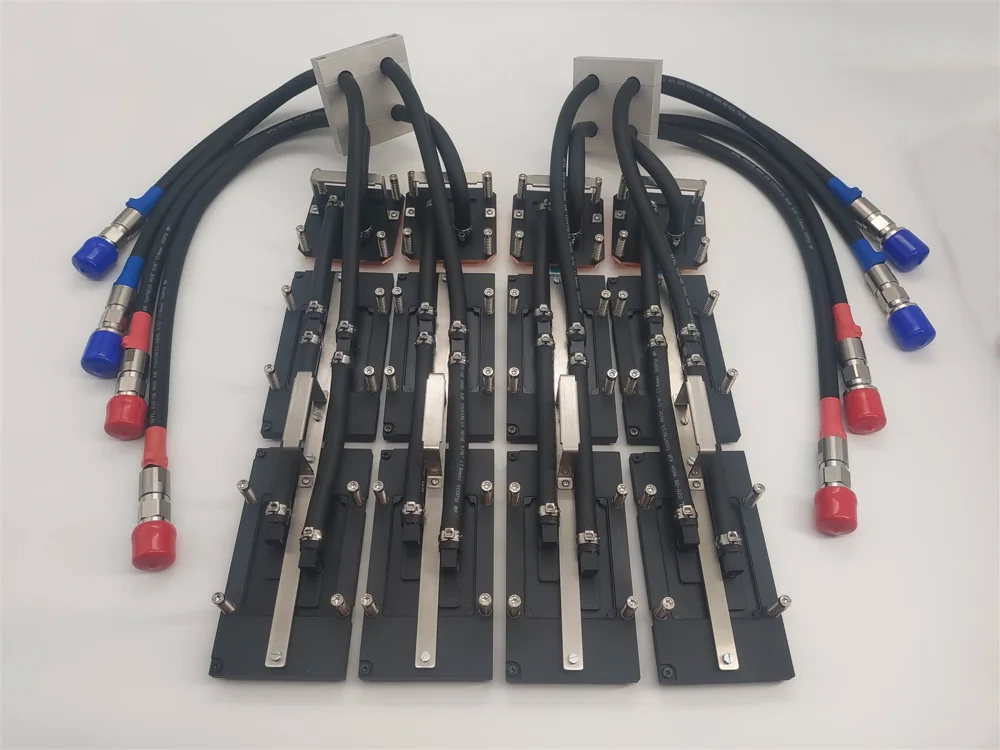
ToneCooling Australia supplies direct-to-chip liquid cold plates for Australian data-centre and HPC programmes — GB200, GB300, H200, AMD EPYC SP5, Intel Birch Stream — designed, engineered and manufactured at our own IATF 16949-aligned manufacturing facility in Huizhou, China, with customer engineering support from Carlton, Victoria. See our data centre liquid cooling and GPU cold plate pages.
Frequently asked questions
When does a data centre need liquid cooling instead of air?
Air cooling is practical up to roughly 8–25 kW per rack. AI GPU racks (e.g. NVIDIA GB200 NVL72) run at 80–120 kW+, so above about 40 kW per rack direct-to-chip liquid cooling with cold plates becomes necessary.
Is liquid cooling more efficient than air cooling?
Yes — direct-to-chip liquid cooling removes heat at the die with far less fan/CRAC energy, lowering PUE and enabling much higher rack density than air cooling.
Are Australian data centres switching to liquid cooling?
Yes. Major AU operators are building liquid-ready AI capacity — AirTrunk's MEL2 uses large-scale direct-to-chip liquid cooling and NEXTDC's M4 AI Factory runs ~100 kW per rack with liquid cooling.
Can existing air-cooled racks be retrofitted to liquid?
High-density AI deployments are best designed liquid-ready, but direct-to-chip cold-plate kits can retrofit GPU/CPU trays where the facility supports a liquid loop and CDU.
Does ToneCooling supply data centre cold plates in Australia?
Yes. ToneCooling Australia supplies direct-to-chip cold plates for GB200/GB300/H200, AMD SP5 and Intel Birch Stream, with Carlton customer engineering support and AS/NZS compliance documentation.
Discuss your BESS thermal design
Send your module layout, cell format, and AS/NZS scope to the Carlton customer engineering support team — an engineer reviews every RFQ and replies by email with next steps.
Request a Quote