
Last updated: 5 October 2026
Rear door heat exchangers for Australian data centre racks
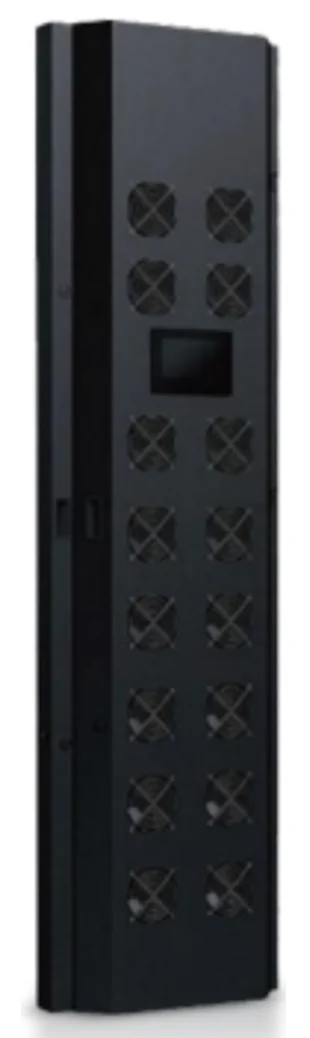
A rear door heat exchanger (RDHx) is a liquid-cooled door that replaces the back panel of a server rack and removes heat from the server exhaust before it reaches the room. ToneCooling supplies active (20 kW) and passive (10.1 kW) rear doors for 600 × 1200 mm racks, often paired with direct-to-chip cold plates so the whole cabinet runs liquid-cooled.
Active or passive rear door heat exchanger?
An active door has its own fan wall and can handle racks without strong server fans. A passive door relies on the servers' own fans to push air through the coil. It uses almost no power, but captures less heat.
Heat exchanger + fan wall
Captures up to 20 kW. Use it on dense racks, mixed air/liquid racks, or where the room's air handling has little spare capacity.
Heat exchanger + mesh door
Captures 10.1 kW with a 30 W draw. Use it where server fans are strong enough and you want the lowest running energy.
What are the rear door heat exchanger specifications?
| Item | TC-RDX-A20 (Active) | TC-RDX-P10 (Passive) |
|---|---|---|
| Cooling capacity | 20 kW @ ΔT 2.7 °C | 10.1 kW @ ΔT 2.6 °C |
| Supply / return liquid | 32 / 34.2 °C | 32 / 34.7 °C |
| Air inlet / outlet | 45 / 34.7 °C | 40 / 34.6 °C |
| Liquid flow | 130 L/min | 55 L/min |
| Air volume | 6300 m³/h | 5950 m³/h |
| Water-side pressure drop | 74.2 kPa | 43 kPa |
| Power supply | 230 V / 50 Hz (configured to order) | 48 VDC |
| Power consumption | 1.1 kW | 30 W |
| Dimensions | 595 × 250 × 2250 mm | 599.5 × 150 × 2195 mm |
| Net / operating weight | 105 / 115 kg | 71.5 / 91.5 kg |
| Matching rack (W × D × H) | 600 × 1200 × 2250 mm | 600 × 1200 × 2200 mm |
How does a rear door heat exchanger run unattended?
- Self-diagnosis and leak detection with safety protection
- HMI showing every alarm signal at the rack
- Standard quick-connect inlet and outlet ports
- Universal casters for fast installation and door swing
- Modular design for any data centre size or layout
Australian design notes
Dew point: the door is rated with 32 °C supply water. Keep supply above the room dew point on humid sites such as Brisbane, Darwin and coastal Sydney, or condensation will form on the coil.
Water source: the 32 °C supply suits a dry cooler loop for much of the year in southern climates, which keeps water use down. See data centre water use.
Electrical: active doors are configured for Australian 230 V / 50 Hz supply to order. The electrical safety compliance pathway for Australia and New Zealand is confirmed per project at quotation.
Rear door questions
Do I need a rear door if my servers already have cold plates?
Often, yes. Cold plates capture the CPU and GPU heat, but memory, drives, NICs and power supplies still heat the air. A rear door captures that residual heat so the room's air conditioning doesn't have to.
Can one CDU feed both the cold plates and the rear door?
It can, if the CDU's secondary supply temperature and flow suit both loads. We size the CDU, manifolds and rear door to one flow and pressure-drop budget. See coolant distribution units.
Does the door fit standard racks?
The doors are matched to 600 × 1200 mm racks at 2200–2250 mm height, including our liquid cooling racks. For other racks, send the rack drawing.
Where is the product supplied from?
ToneCooling supplies the rear doors from China. ToneCooling Australia in Carlton VIC handles selection, AUD quotes, documentation, customs and after-sales.
What does a rear door heat exchanger do?
It captures the heat in the server exhaust air at the back of the rack. Warm air passes through a liquid-cooled coil in the door, and the coolant carries the heat away, so near-neutral air returns to the room.
How is a rear door heat exchanger priced?
Every rear door is quoted per project. The price depends on capacity, active or passive type, power supply, connections and quantity. Send the rack load and supply water temperature through the RFQ. An engineer reviews every RFQ and replies by email with next steps.
Is a rear door heat exchanger better than in-row cooling for server rack cooling?
A rear door cools each rack at its own exhaust, so it suits a few dense racks in an existing room. In-row coolers serve a whole row from the aisle. For racks with direct-to-chip cold plates, a rear door handles the remaining air-cooled heat.
Send your rack load
Tell us the rack power, the share already on cold plates and the supply water temperature. We'll recommend active or passive and check the capacity at your conditions.
- Rack kW and air-cooled share
- Supply water temperature
- Room temperature and humidity
- Rack make and size
Sources and standards referenced: ASHRAE TC 9.9 (data centre thermal guidelines); Open Compute Project cooling environments; Standards Australia (AS/NZS standards). Specifications on this page come from ToneCooling datasheets; project values are confirmed at quotation.