
Last updated: 5 October 2026
Closed circuit cooling towers for liquid-cooled data centres
A closed circuit cooling tower keeps the liquid cooling loop sealed inside its coils, while spray water and air outside the coils carry the heat away. On hot days it can hold a lower supply temperature than a dry cooler. The cost is water use, plus the registration and water treatment rules that come with any cooling tower in Australia.
Dry cooler or closed circuit cooling tower?
Both keep the process loop sealed. The choice comes down to how cold you need the supply, how hot the site gets, and whether you can use water.
| Integrated dry cooling unit | Closed-circuit cooling tower | |
|---|---|---|
| Heat rejection limited by | Dry-bulb temperature | Wet-bulb temperature, which is lower than dry-bulb on most days |
| Water use | None in normal dry operation | Evaporation, blow-down and make-up water |
| Regulation | No cooling tower registration | Generally treated as a cooling tower system under AS/NZS 3666 and state rules |
| Best fit | Warm-water liquid cooling (W32–W45); water-scarce sites | Hot, dry inland sites; loops that need lower supply temperatures |
| ToneCooling range | TC-DCU dry cooling units | TC-CTX and TC-CTC (this page) |
What capacity do counterflow closed circuit cooling towers cover?
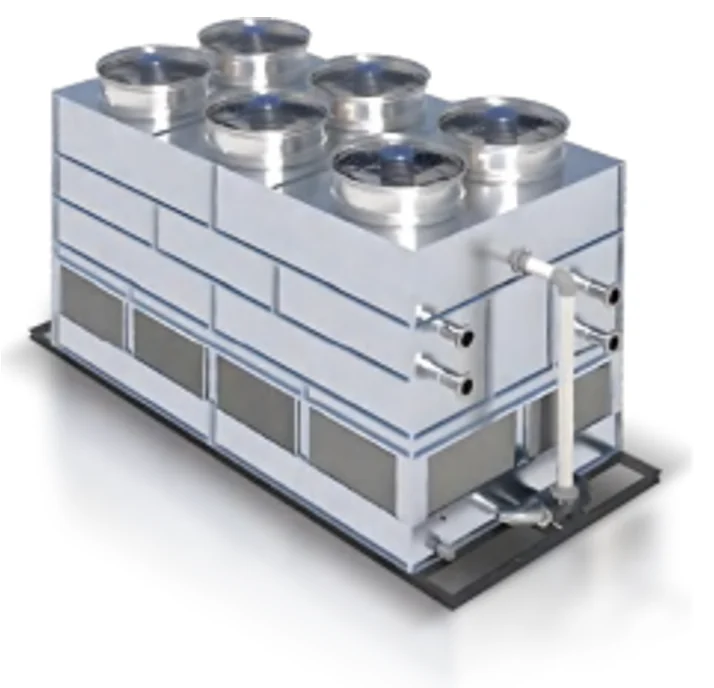
Air enters through louvres around the base and is drawn upward by the top fan, against the falling spray water. There's no pre-cooling fill, so the footprint is small, and the towers handle high-temperature process fluids well. Custom sizes are available to fit container transport.
What capacity do cross-flow closed cooling towers cover?
Air enters through the side grilles and crosses the spray water, coils and PVC fill horizontally before the top fan exhausts it. Several units can be combined for larger loads.
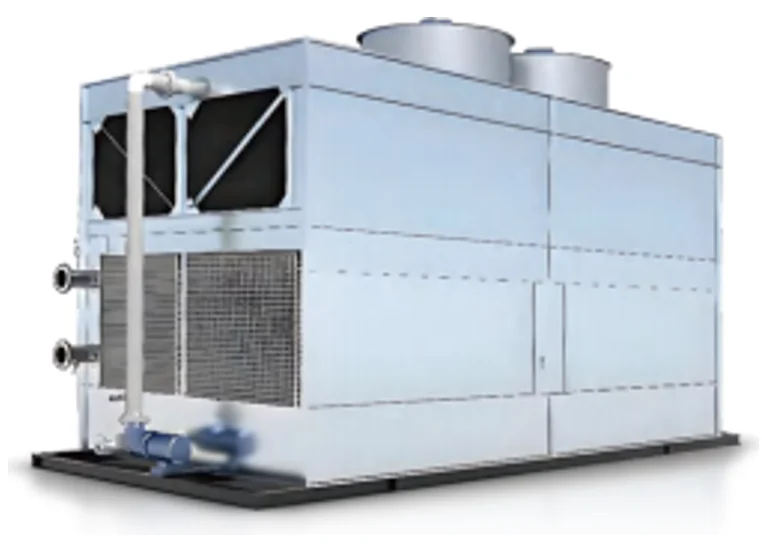
Casing: magnesium-aluminium-zinc coated steel or stainless steel. Coils: stainless steel or copper. 1 RT ≈ 3.517 kW; kW values below are nominal conversions.
TC-CTC counterflow series
| Model | RT | kW | Fan kW | Spray pump (m³/h) | Inlet / outlet | L×W×H (mm) | Net / operating (kg) |
|---|---|---|---|---|---|---|---|
| TC-CTC-006 | 6 | ≈21 | 0.55 | 20 | DN50 | 1550×1000×2145 | 430 / 890 |
| TC-CTC-010 | 10 | ≈35 | 0.55 | 20 | DN50 | 1550×1000×2145 | 490 / 1150 |
| TC-CTC-017 | 17 | ≈60 | 0.75×2 | 20 | DN65 | 2350×1100×2265 | 500 / 1480 |
| TC-CTC-024 | 24 | ≈84 | 0.75×2 | 25 | DN65 | 2350×1100×2265 | 550 / 1610 |
| TC-CTC-031 | 31 | ≈109 | 1.5×2 | 35 | DN80 | 2800×1300×2702 | 710 / 1700 |
| TC-CTC-043 | 43 | ≈151 | 1.5×2 | 35 | DN80 | 2800×1300×2702 | 800 / 1800 |
| TC-CTC-052 | 52 | ≈183 | 1.5×2 | 65 | DN100 | 2800×1500×2952 | 930 / 2100 |
| TC-CTC-061 | 61 | ≈215 | 1.5×2 | 65 | DN100 | 2800×1500×2952 | 990 / 2200 |
| TC-CTC-079 | 79 | ≈278 | 2.2×2 | 100 | DN100 | 2800×1700×2952 | 1200 / 2550 |
| TC-CTC-098 | 98 | ≈345 | 3×2 | 100 | DN100 | 3200×2000×3252 | 1580 / 3180 |
| TC-CTC-122 | 122 | ≈429 | 3×2 | 110 | DN125 | 3200×2000×3252 | 1750 / 3350 |
| TC-CTC-132 | 132 | ≈464 | 3×2 | 110 | DN150 | 3550×2000×3252 | 2230 / 4130 |
| TC-CTC-152 | 152 | ≈535 | 4×2 | 150 | DN150 | 4200×2000×3612 | 2045 / 4345 |
| TC-CTC-180 | 180 | ≈633 | 5.5×2 | 180 | DN200 | 4200×2000×3612 | 2250 / 5050 |
| TC-CTC-213 | 213 | ≈749 | 5.5×2 | 180 | DN200 | 4200×2000×3612 | 2520 / 5420 |
| TC-CTC-244 | 244 | ≈858 | 7.5×2 | 230 | DN200 | 5100×3000×4356 | 3080 / 7580 |
| TC-CTC-274 | 274 | ≈964 | 7.5×2 | 270 | DN250 | 5100×3000×4356 | 3660 / 8160 |
| TC-CTC-305 | 305 | ≈1073 | 7.5×2 | 270 | DN250 | 5100×3000×4356 | 4050 / 8680 |
| TC-CTC-335 | 335 | ≈1178 | 11×2 | 360 | DN250 | 6000×3000×4474 | 5290 / 9890 |
| TC-CTC-360 | 360 | ≈1266 | 11×2 | 360 | DN250 | 6000×3000×4474 | 5470 / 10070 |
| TC-CTC-398 | 398 | ≈1400 | 15×2 | 460 | DN200×2 | 6600×3000×4550 | 5700 / 11900 |
| TC-CTC-440 | 440 | ≈1547 | 15×2 | 460 | DN200×2 | 6600×3000×4550 | 5990 / 13500 |
TC-CTX cross-flow series
| Model | RT | kW | Fan kW | Spray pump (m³/h) | Inlet / outlet | L×W×H (mm) | Net / operating (kg) |
|---|---|---|---|---|---|---|---|
| TC-CTX-031 | 31 | ≈109 | 0.75×2 | 35 | DN80 | 2700×1600×2550 | 1320 / 2720 |
| TC-CTX-043 | 43 | ≈151 | 1.1×2 | 40 | DN80 | 2800×1650×2550 | 1650 / 3050 |
| TC-CTX-052 | 52 | ≈183 | 1.5×2 | 55 | DN80 | 2800×2000×2650 | 1850 / 3550 |
| TC-CTX-061 | 61 | ≈215 | 1.5×2 | 65 | DN100 | 2800×2000×2650 | 2160 / 3860 |
| TC-CTX-079 | 79 | ≈278 | 2.2×3 | 80 | DN100 | 3400×2200×2750 | 2650 / 4850 |
| TC-CTX-098 | 98 | ≈345 | 2.2×3 | 110 | DN100 | 4500×2400×3300 | 3140 / 6440 |
| TC-CTX-122 | 122 | ≈429 | 3×3 | 110 | DN125 | 4500×2400×3300 | 3400 / 6700 |
| TC-CTX-132 | 132 | ≈464 | 3×3 | 140 | DN125 | 4500×2400×3300 | 3830 / 7130 |
| TC-CTX-152 | 152 | ≈535 | 4×3 | 150 | DN150 | 4500×2700×3450 | 4040 / 7840 |
| TC-CTX-180 | 180 | ≈633 | 4×3 | 180 | DN200 | 4500×2700×3450 | 4250 / 8050 |
| TC-CTX-213 | 213 | ≈749 | 4×3 | 210 | DN200 | 4500×2700×3450 | 4580 / 8280 |
| TC-CTX-244 | 244 | ≈858 | 4×4 | 250 | DN150×2 | 5450×2700×3450 | 4930 / 9630 |
| TC-CTX-274 | 274 | ≈964 | 4×4 | 250 | DN150×2 | 5450×2700×3520 | 5120 / 9850 |
| TC-CTX-305 | 305 | ≈1073 | 4×4 | 270 | DN150×2 | 5800×2900×3520 | 5590 / 10590 |
| TC-CTX-335 | 335 | ≈1178 | 4×4 | 300 | DN150×2 | 5800×2900×3520 | 5710 / 10710 |
| TC-CTX-360 | 360 | ≈1266 | 5.5×4 | 300 | DN150×2 | 6400×2900×3570 | 6500 / 12300 |
| TC-CTX-398 | 398 | ≈1400 | 5.5×4 | 300 | DN200×2 | 6400×3000×3570 | 6820 / 12820 |
Cooling tower rules in Australia
A closed-circuit tower still recirculates spray water outdoors. Most states treat it as a cooling tower system: it must be registered with the state health department and run under a risk management plan with routine water treatment and Legionella testing. AS/NZS 3666 sets the design, installation and maintenance requirements.
Requirements differ between Victoria, NSW, Queensland and the other states. Confirm them with your local authority and water treatment contractor before you choose a tower.
How is a closed circuit cooling tower matched to the CDU loop?
- Tower selection at your site's design wet-bulb temperature
- Matched CDU on the same primary loop. CDUs
- Pump skids for primary circulation. Pump skids
- Documentation handed over to your mechanical contractor and water treatment provider
Cooling tower questions
Why not just use an open cooling tower?
An open tower exposes the process water to air, dust and biological growth. Liquid cooling loops need clean, stable coolant, so a closed-circuit tower, or an open tower behind a plate heat exchanger, keeps the CDU's primary loop clean.
How is the tower rated?
Nominal capacities are in refrigeration tons (RT) at the catalogue design condition. We re-select every tower at your site's design wet-bulb temperature and your loop temperatures before quoting.
Where are the towers supplied from?
ToneCooling supplies the towers from China. ToneCooling Australia handles selection, AUD quotes, documentation, freight coordination and after-sales.
What are the Australian standards for cooling towers?
AS/NZS 3666 covers the design, installation, operation and maintenance of air-handling and water systems, including cooling towers. Each state adds its own registration and risk management rules, so confirm them with your local authority.
What is the difference between open circuit and closed circuit cooling towers?
In an open circuit tower the process water is sprayed directly into the air stream. In a closed circuit tower the process fluid stays sealed inside a coil, and only a separate spray water circuit touches the air, so the liquid cooling loop stays clean.
Is a closed circuit cooling tower a water cooling tower?
Yes, it is a type of water cooling tower. Spray water evaporates outside the coil to reject heat, but the process fluid stays sealed inside the coil instead of being sprayed through the tower like in an open cooling tower.
Closed circuit cooling tower, coil cooler or adiabatic cooler?
A coil cooler (fluid cooler) is another name for a closed circuit cooling tower: the fluid stays sealed in a coil that is wetted by spray water. An adiabatic cooler is a dry cooler that only pre-cools the incoming air with water on hot days, so it uses less water but reaches higher supply temperatures.
Send your heat load and site
Send the total heat load, the loop temperatures and the site location. We'll compare tower and dry cooler options at your design weather.
- Heat load (kW)
- Supply / return temperature
- Site location
- Water availability
Sources and standards referenced: Victoria Department of Health: cooling tower systems; NSW Health: Legionella control; ASHRAE TC 9.9 (data centre thermal guidelines). Specifications on this page come from ToneCooling datasheets; project values are confirmed at quotation.